

SS-31, also known as elamipretide, is a synthetic tetrapeptide studied for its interaction with mitochondria and cardiolipin, a specialized phospholipid concentrated within the inner mitochondrial membrane. Researchers are particularly interested in SS-31 because mitochondrial membrane organization plays an important role in cellular energy production and normal mitochondrial function.
Laboratory and preclinical research has explored SS-31 in relation to mitochondrial respiration, ATP production, oxidative stress, membrane stability and cellular responses to metabolic stress. These areas of investigation have led to research involving skeletal muscle, cardiac tissue, kidney tissue, neurological systems and other tissues with high energy requirements.
SS-31 provides researchers with a specialized tool for investigating mitochondrial biology, cardiolipin interactions and cellular energetics under controlled experimental conditions. Research findings depend on the model, concentration, chemical form and experimental design used. This material is intended for laboratory research only, is not authorized by Health Canada for human therapeutic use, and is not intended for human or veterinary administration.
Choose a kit option to save more, or skip this and buy individually above.



*LC-MS identity confirmation may be performed when analytical review indicates conflicting, atypical, or inconclusive results.
SS-31, also known as elamipretide, is a synthetic tetrapeptide composed of four amino-acid or amino-acid-derived residues. Its sequence is commonly represented as D-Arg–Dmt–Lys–Phe–NH₂, where Dmt represents 2,6-dimethyltyrosine.
Unlike many naturally occurring peptides, SS-31 contains a D-amino-acid residue, a modified tyrosine residue and a C-terminal amide. These structural characteristics contribute to its distinctive chemical properties and are important when researchers evaluate peptide identity and analytical characterization.
SS-31 has attracted scientific interest primarily because of its relationship with mitochondria. Mitochondria are responsible for producing much of the energy required for cellular activity, making mitochondrial function particularly important in tissues with high and continuous energy requirements.
Mitochondria generate cellular energy primarily through oxidative phosphorylation, a process involving the electron transport chain located within the inner mitochondrial membrane. The energy produced through this system is converted into adenosine triphosphate, or ATP, which cells use to support numerous biological processes.
The organization and integrity of the inner mitochondrial membrane are important to this process. Changes in mitochondrial membrane structure can influence electron transport, ATP generation, reactive oxygen species production and overall cellular energetics.
Researchers use SS-31 to explore these interconnected processes and to investigate how mitochondrial membrane biology may influence cellular function under both normal and experimentally stressed conditions.
One of the major areas of SS-31 research involves cardiolipin, a specialized phospholipid found predominantly within the inner mitochondrial membrane.
Cardiolipin helps organize and stabilize several proteins and protein complexes involved in mitochondrial energy production. Because these structures depend on an organized membrane environment, changes involving cardiolipin can influence mitochondrial respiration and membrane function.
SS-31 has been studied for its ability to interact with cardiolipin. Researchers investigate whether this interaction can influence mitochondrial membrane organization, mitochondrial protein function and the cellular processes that depend on efficient energy production.
This cardiolipin-associated mechanism distinguishes SS-31 from many research peptides that primarily interact with extracellular receptors or circulating signalling pathways.
A major focus of SS-31 research involves mitochondrial energy production.
Laboratory and animal studies have investigated measurements such as mitochondrial respiration, electron transport activity and ATP production. These measurements allow researchers to evaluate how efficiently mitochondria convert available nutrients and oxygen into usable cellular energy.
This area of research is particularly relevant in tissues such as skeletal muscle and cardiac tissue, where cells require substantial and continuous amounts of ATP.
SS-31 therefore provides researchers with a method of studying how mitochondrial membrane organization and cardiolipin interactions may relate to cellular energy production and tissue function.
Mitochondria naturally generate reactive oxygen species as part of normal cellular metabolism. Under certain experimental conditions, excessive reactive oxygen species can contribute to oxidative stress and affect proteins, membrane lipids and other cellular structures.
Research involving SS-31 has examined whether changes within the mitochondrial membrane environment may influence reactive oxygen species production and the cellular response to oxidative stress.
Researchers have evaluated these processes using biochemical measurements of mitochondrial function, oxidative markers and tissue responses under controlled experimental conditions.
These findings have contributed to broader research examining the relationship between mitochondrial efficiency, oxidative processes and cellular resilience.
Skeletal muscle has been an important area of SS-31 research because muscle cells rely heavily on mitochondrial ATP production.
Experimental studies have examined mitochondrial respiration, cellular energy availability, muscle energetics and functional measurements under conditions associated with mitochondrial stress or altered energy production.
Cardiac tissue has also received considerable research attention because the heart has exceptionally high and continuous energy requirements. Experimental models have evaluated mitochondrial membrane function, energy production, oxidative processes and tissue responses under metabolic or ischemic stress.
These studies provide researchers with additional ways to examine how mitochondrial biology may influence tissues with particularly high energy demands.
SS-31 has also been investigated in kidney, neurological and other experimental models involving mitochondrial dysfunction or cellular stress.
Kidney tissue contains large numbers of mitochondria because many renal processes require substantial amounts of energy. Researchers have therefore examined mitochondrial respiration, oxidative processes and cellular responses in experimental kidney models.
Neurological research has similarly explored mitochondrial function because neurons require consistent energy production to maintain normal cellular activity.
Additional research models have investigated age-associated mitochondrial changes, metabolic stress and other conditions where mitochondrial efficiency may become altered.
The significance of these findings depends on the specific model and experimental conditions used and should not automatically be transferred from one tissue or research setting to another.
Elamipretide has progressed beyond preclinical investigation and has also been evaluated extensively in human clinical research.
This provides SS-31 with a larger translational research background than many experimental peptides. Human studies have investigated mitochondrial disorders and conditions in which altered mitochondrial function may contribute to disease processes.
However, findings involving pharmaceutical-grade elamipretide cannot automatically be transferred to independently manufactured SS-31 research material. Pharmaceutical formulations are produced under defined manufacturing, purity, concentration, stability and quality-control requirements.
Research-grade SS-31 should therefore be evaluated according to its own manufacturing documentation and batch-specific analytical testing.
Research involving SS-31 should be interpreted according to the specific experimental system in which the findings were produced.
Results obtained in cultured cells may not reproduce the same outcome in intact tissues. Animal findings may not translate directly to humans, and findings involving regulated pharmaceutical elamipretide cannot establish the characteristics of independently manufactured research material.
Concentration, exposure duration, chemical form, counterion, experimental model, tissue type and analytical method can all influence study outcomes.
Researchers should therefore evaluate SS-31 according to the specific material, analytical documentation and experimental conditions used rather than treating results from one study as universally applicable.
SS-31 remains an actively studied compound within mitochondrial and cellular-energy research.
Its interaction with cardiolipin has generated particular interest in research involving mitochondrial membrane organization, oxidative phosphorylation, ATP production, reactive oxygen species and cellular responses to metabolic stress.
For research purposes, SS-31 provides a specialized experimental compound for investigating these mechanisms individually and examining how they interact within broader mitochondrial systems.
This material is supplied exclusively for controlled laboratory research. It is not intended for human or veterinary use.
SS-31 is a synthetic modified tetrapeptide commonly known as elamipretide. The compound contains four amino-acid or amino-acid-derived residues and is primarily studied in mitochondrial and cardiolipin-related research.
The product name SS-31 does not by itself establish the exact counterion, salt form, hydration state or composition of a supplied batch. These characteristics should be determined from the applicable manufacturing and analytical documentation.
SS-31 consists of D-arginine, 2,6-dimethyltyrosine, lysine and phenylalanine with a C-terminal amide.
The use of D-arginine and the modified Dmt residue distinguishes SS-31 structurally from conventional naturally occurring tetrapeptides.
Reported molecular weight can differ when SS-31 is supplied as a salt or with an associated counterion. Molecular calculations should therefore use the chemical form documented for the applicable batch rather than automatically applying the molecular weight of free elamipretide.
Physical characteristics can vary depending on manufacturing method, peptide form, counterion, residual moisture and processing conditions.
The term “lyophilized” should be used only when freeze-drying has been confirmed as part of the manufacturing process. Powder appearance or cake structure cannot independently establish identity, purity or quantity.
Analytical characterization of SS-31 may use complementary techniques because purity, molecular identity and total quantity represent separate measurements.
High-performance liquid chromatography may be used to evaluate peptide-related purity by separating the principal component from impurities detected under a defined analytical method.
Mass spectrometry may provide supporting evidence for molecular identity by detecting ions consistent with the expected elamipretide molecule.
Depending on the research application, analytical characterization may include:
A single analytical method should not be interpreted as establishing characteristics that the method was not designed to measure.
Analytical results should be reported specifically for the applicable batch.
HPLC area purity should not be multiplied by nominal vial weight and presented as confirmed SS-31 quantity unless total peptide content has been independently established.
Keep unopened research material in its original sealed container and protect it from direct light and moisture.
Storage temperature should follow the conditions supported by the manufacturer, supplier documentation, batch record or applicable stability information. Repeated unnecessary temperature changes should be avoided.
Where refrigerated or frozen storage is specified, the sealed container should be allowed to approach the intended laboratory handling temperature before opening when condensation is a concern.
Stability following opening, transfer or preparation should not be assumed unless supported by appropriate stability data.
Any expiry or retest date should be supported by manufacturing or stability documentation for the applicable material.
HPLC purity represents chromatographic purity under the conditions of the analytical method used. It does not independently establish total vial quantity, molecular identity, sterility, endotoxin level, counterion concentration or residual-solvent content.
Mass spectrometry can provide evidence supporting molecular identity but does not independently determine chromatographic purity, total quantity or sterility.
The molecular weight of free elamipretide should not automatically be applied when the supplied material contains a salt, counterion, hydrate or other associated component.
Batch-specific analytical documentation should therefore be used when reporting quantitative or qualitative product characteristics.
This material is supplied exclusively for controlled laboratory research.
It is not manufactured or released as a finished pharmaceutical drug, injectable preparation, food, dietary supplement, natural health product, veterinary product or finished cosmetic.
It is not intended for:
No human dosage, administration route, reconstitution protocol or treatment schedule is provided.
For laboratory research only. Not for human or veterinary use.
These specifications describe the general identity, physical characteristics, analytical considerations and intended research classification of SS-31.
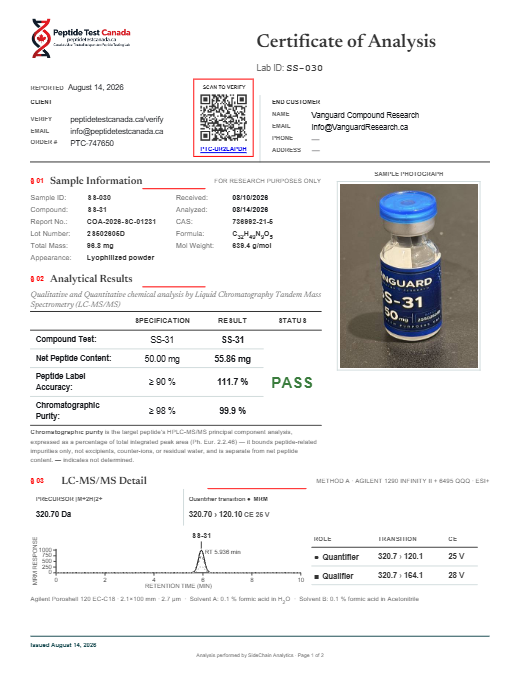
Final product information should be based on the Certificate of Analysis and manufacturing documentation associated with the applicable batch.
Where general product information and batch-specific analytical documentation differ, the batch-specific documentation should control.
Customers should review the applicable analytical records before beginning laboratory research.
Additional documentation available upon request.
Each batch undergoes analytical review using validated laboratory procedures. HPLC testing is utilized to assess purity and compare the sample profile against established reference standards. Where additional verification is warranted, LC-MS analysis may be performed to support compound identity confirmation.
*See LC-MS Confirmation Information for full details.
Every batch supplied by Vanguard Compound Research is assigned a unique batch number and maintained under documented quality-control procedures with supporting analytical documentation available upon request.
All Vanguard Compound Research orders are shipped directly from within Canada, ensuring efficient delivery, reliable service, and consistent quality-control from fulfillment to arrival.
Products are maintained under documented quality-control procedures to help ensure quality, consistency, and transparency.
Each product is assigned a unique lot number, allowing researchers to match their item directly to its corresponding Certificate of Analysis (COA).
Supporting analytical documentation may be available for qualifying products, including batch-specific quality records and testing information.
Documentation may include: