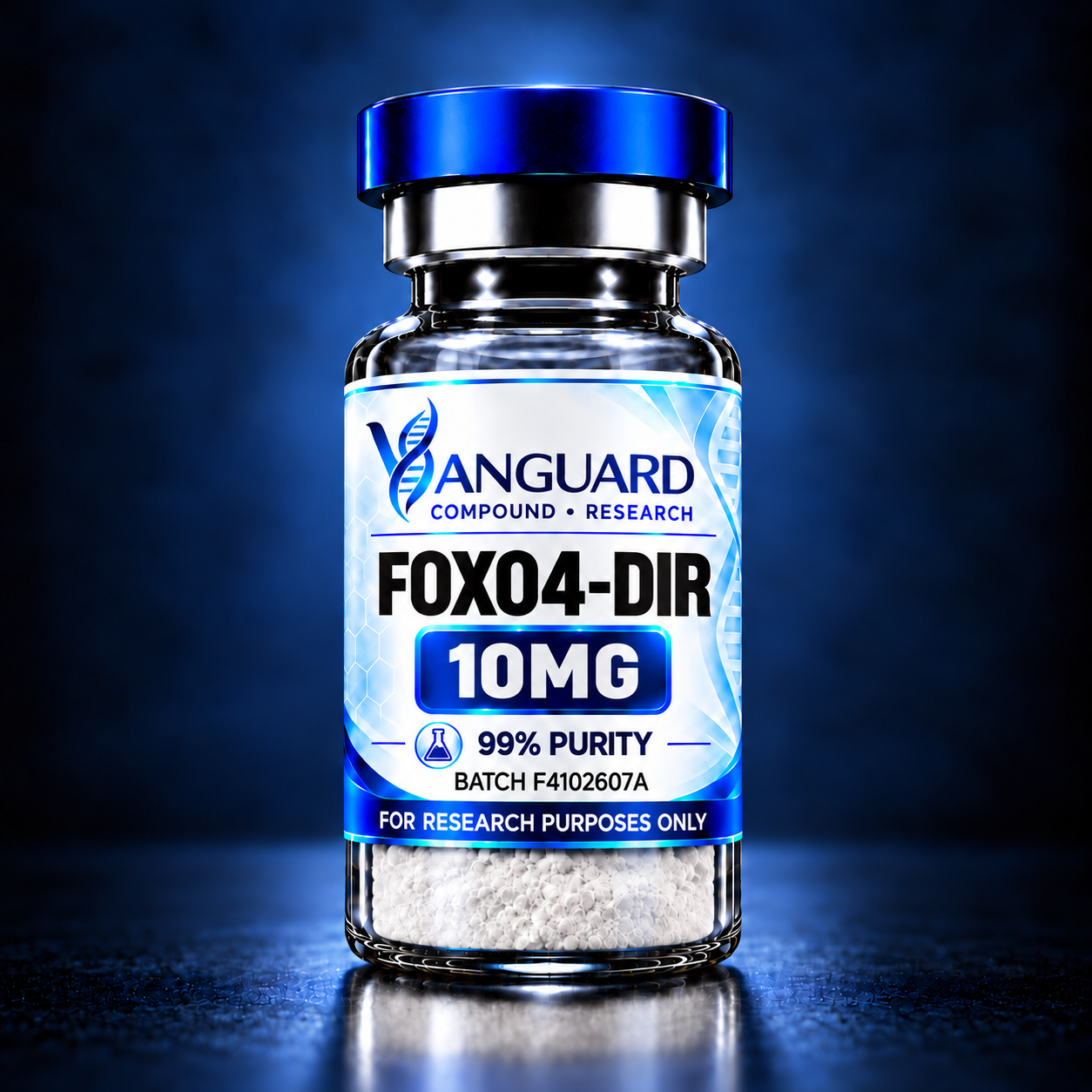
FOXO4-DRI is an experimental D-retro-inverso peptide developed for research into cellular senescence, apoptosis, and the molecular processes associated with aging and tissue homeostasis. It was designed to interfere with the interaction between the transcription factor FOXO4 and the tumor-suppressor protein p53, an interaction that appears to help certain senescent cells resist programmed cell death. In laboratory studies, disruption of this interaction has caused p53 redistribution and preferential apoptosis of senescent cells compared with non-senescent control cells. PubMed Central (PMC)
The compound uses an all-D, retro-inverso peptide architecture, which is intended to maintain a biologically relevant side-chain arrangement while increasing resistance to normal proteolytic degradation. FOXO4-DRI also incorporates a highly basic cell-penetrating region that supports intracellular research applications. Preclinical research has explored FOXO4-DRI in areas including cellular aging, tissue homeostasis, cartilage biology, fibroblast senescence, endocrine aging, vascular senescence, and models of treatment-associated cellular damage. PubChem
FOXO4-DRI remains an investigational research compound, and the published evidence is predominantly based on cell-culture and animal models rather than controlled administration to humans. This material is intended for laboratory research only, is not authorized by Health Canada for human therapeutic use, and is not intended for human or veterinary administration.
Choose a kit option to save more, or skip this and buy individually above.

*LC-MS identity confirmation may be performed when analytical review indicates conflicting, atypical, or inconclusive results.
FOXO4-DRI, short for FOXO4 D-Retro-Inverso, is a synthetic research peptide created to investigate one of the mechanisms that may allow senescent cells to remain alive even after they have permanently stopped dividing.
Cellular senescence is a biological state in which a cell experiences sufficient stress or damage that it permanently exits the normal cell cycle. This response can initially be protective because it prevents damaged cells from continuing to replicate. The difficulty arises when senescent cells remain within tissues for extended periods.
These cells can develop a characteristic secretory pattern commonly referred to as the senescence-associated secretory phenotype, or SASP. Through the release of inflammatory cytokines, growth factors, proteases, and other signaling molecules, senescent cells can influence surrounding cells and alter the local tissue environment.
FOXO4-DRI was designed as a molecular tool for studying whether a specific survival pathway involving FOXO4 and p53 can be disrupted in senescent cells. The original work describing the peptide was published in Cell in 2017 and established FOXO4 as an important regulator of senescent-cell survival. PubMed Central (PMC)
FOXO4 — Forkhead Box O4 — is a transcription factor.
FOXO proteins regulate numerous cellular processes associated with:
Researchers observed that FOXO4 becomes particularly relevant inside certain senescent cells.
Rather than simply functioning as a general aging marker, FOXO4 appears capable of interacting directly with p53, another major cellular stress-response protein.
This FOXO4–p53 interaction became the molecular target around which FOXO4-DRI was developed.
p53 is one of the most extensively studied proteins in molecular biology.
It responds to cellular stress and DNA damage and can influence whether a damaged cell:
In the original FOXO4 research, investigators found that FOXO4 could interact with p53 in senescent cells and help retain p53 within the nucleus.
The researchers proposed that this interaction contributed to the unusual ability of senescent cells to remain alive despite extensive cellular damage.
FOXO4-DRI was therefore developed to interfere with this protein–protein interaction. PubMed Central (PMC)
The structural design of FOXO4-DRI is an important part of what distinguishes it from an ordinary peptide.
Most naturally occurring proteins are constructed primarily from L-amino acids.
FOXO4-DRI instead uses amino acids in the D-configuration.
Many naturally occurring proteolytic enzymes recognize L-amino-acid peptides more easily than equivalent D-peptides. Using D-amino acids can therefore substantially change peptide stability and susceptibility to enzymatic degradation.
The term retro-inverso refers to a peptide design in which the amino-acid orientation and sequence direction are altered in a way intended to reproduce a similar spatial arrangement of important side chains.
The objective is not simply to reverse a peptide.
The approach attempts to preserve aspects of the original interaction surface while creating a peptide with substantially different backbone chemistry.
This characteristic was particularly important in the original FOXO4 experiments: the investigators reported that the D-retro-inverso construct showed considerably greater activity against senescent cells than the corresponding conventional L-peptide. PubMed Central (PMC)
FOXO4-DRI is approximately 46 amino-acid residues long and contains a strongly basic, arginine-rich cell-penetrating region.
PubChem records the sequence as:
LTLRKEPASEIAQSILEAYSQNGWANRRSGGKRPPPRRRQRRKKRG
with the compound represented in its D-amino-acid configuration. PubChem
The arginine-rich portion resembles established TAT-type cell-penetrating peptide sequences.
This component is important because the FOXO4–p53 interaction occurs inside the cell. A peptide intended to study this interaction must therefore be capable of accessing intracellular environments rather than acting only at the cell surface.
The central research model for FOXO4-DRI can be simplified into several stages.
1. Cellular stress leads to senescence.
A damaged cell permanently withdraws from the normal cell cycle.
2. FOXO4 becomes associated with p53 within the senescent cell.
3. The FOXO4–p53 interaction contributes to retention of p53 within nuclear structures.
4. FOXO4-DRI competes with or disrupts this interaction.
5. p53 is redistributed away from its FOXO4-associated nuclear localization.
6. In susceptible senescent cells, this process can activate p53-dependent intrinsic apoptosis.
The important distinction is that FOXO4-DRI is being investigated as a protein–protein interaction disruptor, rather than as a conventional receptor agonist or antagonist.
The original experiments found substantially greater sensitivity in senescent cells than corresponding non-senescent cells under the studied laboratory conditions. PubMed Central (PMC)
FOXO4-DRI is primarily studied in the field of senescence biology.
Researchers can use it to investigate questions such as:
Because its proposed target is a molecular survival mechanism rather than senescence itself, FOXO4-DRI is especially useful for studying the relationship between cellular aging and apoptosis resistance.
The original animal research examined both naturally aged mice and models of accelerated aging.
Investigators reported changes in several functional measures following experimental elimination of senescent cells, including measures involving physical activity, fur density and renal function. These findings provided early evidence that removing established senescent cells could influence tissue function in living animal models. ScienceDirect
These results should not be interpreted as evidence that FOXO4-DRI reverses human aging.
They instead provide a model through which researchers can examine whether accumulated senescent cells contribute directly to declining tissue function.
The original FOXO4-DRI publication also examined a model involving doxorubicin-induced cellular damage.
Chemotherapeutic stress can generate substantial DNA damage and induce cellular senescence in surviving cells.
Researchers therefore used FOXO4-DRI to investigate whether removal of these persistent senescent populations could alter downstream tissue effects associated with experimental chemotoxicity.
The mouse research demonstrated reductions in several adverse tissue effects under the conditions studied. PubMed Central (PMC)
This represents a preclinical mechanistic research application, not an established cancer-treatment application.
FOXO4-DRI has also been studied using human chondrocytes expanded in vitro.
Chondrocytes are the specialized cells responsible for maintaining cartilage tissue.
Extended culture can result in a progressively increasing population of senescent cells, making cultured chondrocytes useful for examining how senescence affects cartilage-cell populations.
Researchers reported that FOXO4-DRI could preferentially reduce senescent-cell populations within these experimental cultures and subsequently investigate characteristics of the remaining chondrocytes. Frontiers
This has created interest in FOXO4-DRI as a laboratory tool for research involving:
FOXO4-DRI has also been investigated in senescent Leydig cells.
Leydig cells are located within the testes and play an important role in testosterone production.
A published mouse study examined whether age-associated accumulation of senescent Leydig cells could contribute to declining testicular function.
Researchers reported that disruption of the FOXO4–p53 interaction promoted apoptosis in experimentally senescent Leydig cells, while studies in aged mice identified changes in the testicular microenvironment and testosterone secretion. PubMed
These findings remain preclinical and should not be interpreted as demonstrating a treatment for testosterone deficiency in humans.
They are valuable primarily because they connect cellular senescence with age-related endocrine biology.
More recent research has examined FOXO4-DRI in senescent fibroblasts, including fibroblasts associated with keloid tissue.
Fibroblasts are responsible for producing much of the extracellular matrix that gives connective tissue its structure.
Senescent fibroblasts can develop altered signaling patterns that potentially influence inflammation, collagen production, tissue remodeling, and neighboring cells.
Experimental research published in Communications Biology examined FOXO4-DRI-mediated apoptosis in senescent keloid fibroblasts and further investigated the relationship between FOXO4, p53 phosphorylation and p53 nuclear localization. PubMed Central (PMC)
This expands FOXO4-DRI research beyond generalized aging models and into more specific questions involving senescence-associated tissue remodeling.
Endothelial cells line blood vessels and are highly responsive to oxidative stress, inflammation and metabolic changes.
As these cells become senescent, their normal signaling and vascular functions can change.
FOXO4-DRI has consequently become a research tool for examining whether the FOXO4–p53 pathway contributes to endothelial-cell senescence and whether selective manipulation of senescent endothelial populations changes downstream molecular pathways.
Recent animal and cellular work continues to investigate FOXO4-DRI in this area. PubMed Central (PMC)
FOXO4-DRI is notable because it approaches cellular senescence from a different direction than many traditional compounds.
Instead of broadly inhibiting an enzyme or stimulating a receptor, it was specifically designed to interfere with a protein–protein interaction that appears particularly important for survival of certain senescent cells.
That makes FOXO4-DRI relevant to research involving:
It is therefore best understood as a specialized experimental tool for senescence research.
Despite significant scientific interest, the evidence surrounding FOXO4-DRI remains primarily preclinical.
Much of the foundational work consists of:
There is currently no established clinical dose, therapeutic indication, pharmacokinetic profile, long-term human safety profile, or validated treatment protocol for FOXO4-DRI.
Consequently, findings from cultured cells or animals cannot automatically be assumed to occur in humans.
FOXO4-DRI is an investigational research compound and is not authorized by Health Canada for therapeutic use.
For laboratory research only. Not for human or veterinary use.
Product Name: FOXO4-DRI
Full Name: FOXO4 D-Retro-Inverso Peptide
Alternative Names: FOXO4 DRI, FOXO4-p53 Interfering Peptide
Research Classification: Experimental senolytic research peptide
Primary Research Target: FOXO4–p53 protein interaction
Chemical Class: Synthetic all-D retro-inverso cell-penetrating peptide
Format: Lyophilized powder
Nominal Strength: 10 mg per vial
Research Status: Investigational / preclinical research compound
CAS Number: 2460055-10-9
PubChem CID: 167312269
Molecular Formula: C₂₂₈H₃₈₈N₈₆O₆₄
Molecular Weight: approximately 5,358 g/mol
Peptide Length: 46 amino-acid residues
Configuration: Predominantly/all D-amino-acid retro-inverso construct
Structural Type: Cell-penetrating synthetic peptide
Primary Molecular Interaction: FOXO4–p53 protein-protein interface PubChem
Sequence Representation:
LTLRKEPASEIAQSILEAYSQNGWANRRSGGKRPPPRRRQRRKKRG
The sequence alone does not completely describe FOXO4-DRI because the D-amino-acid stereochemistry and retro-inverso architecture are fundamental parts of the molecule's identity.
FOXO4-DRI combines several structural characteristics.
FOXO4-derived interaction region:
Designed to reproduce molecular features involved in FOXO4 binding to p53.
D-amino-acid construction:
Provides a peptide backbone that differs stereochemically from conventional naturally occurring L-peptides.
Retro-inverso architecture:
Designed to retain relevant side-chain positioning while modifying peptide-backbone orientation.
Arginine-rich cell-penetrating region:
Supports intracellular access required for investigating the FOXO4–p53 interaction.
High positive charge:
The large number of arginine and lysine residues gives FOXO4-DRI strongly basic physicochemical characteristics.
FOXO4-DRI is primarily investigated as a FOXO4–p53 interaction disruptor.
The proposed experimental sequence involves:
Target: FOXO4-associated p53 retention
Primary interaction: FOXO4 ↔ p53
Observed downstream event: alteration of p53 localization
Cellular response under studied conditions: activation of p53-dependent intrinsic apoptosis in susceptible senescent cells
Research objective: examination of selective senescent-cell clearance and resulting changes in cellular or tissue biology. PubMed Central (PMC)
The mechanism remains an area of ongoing investigation and should not be interpreted as an established therapeutic mechanism in humans.
Physical Form: Lyophilized peptide material
Typical Appearance: White to off-white lyophilized solid or powder
Peptide Size: Large synthetic peptide, approximately 5.36 kDa
Charge Characteristics: Strongly basic / cationic because of multiple arginine and lysine residues
Counterion: May vary by manufactured material; TFA and acetate forms have appeared in research literature and commercial reference material
Hygroscopicity: Peptide material should be protected from excessive moisture
Light Exposure: Minimize unnecessary prolonged light exposure
Actual appearance and physical characteristics should always be compared with the documentation supplied for the individual production lot.
Because FOXO4-DRI is a relatively large synthetic peptide, multiple analytical techniques may be appropriate for characterization.
High-performance liquid chromatography can be used to evaluate:
A reported HPLC purity percentage describes the relative chromatographic composition of the tested material and does not by itself determine the total milligrams of active peptide present in the vial.
Mass spectrometry can support:
The expected molecular mass for the PubChem-listed FOXO4-DRI structure is approximately 5,358 Da. PubChem
A robust identity assessment may combine:
Because FOXO4-DRI relies heavily on stereochemical configuration, conventional molecular mass alone cannot fully demonstrate that every amino acid is present in the required D-configuration.
A standard mass spectrometer primarily measures molecular mass.
An all-L peptide and the corresponding all-D peptide can possess essentially the same molecular formula and molecular mass.
Therefore:
Correct LC-MS molecular mass does not independently prove D-amino-acid stereochemistry.
Confirmation of the intended stereochemical configuration may require:
This distinction is especially important for FOXO4-DRI because its retro-inverso configuration is central to the research compound itself.
Purity and peptide content are separate measurements.
A vial may contain:
For this reason, the physical weight of lyophilized material should not automatically be interpreted as pure peptide mass.
Similarly, a chromatographic result such as 99% HPLC purity describes the relative purity of detected chromatographic material and should not automatically be interpreted as a quantitative peptide-content assay.
Where quantitative peptide content is important, an appropriately validated assay against a qualified reference standard or independent quantitative method should be used.
Each production batch should be evaluated independently.
Depending on the analytical program, lot documentation may include:
Identity
Confirmation of the expected FOXO4-DRI analyte.
Purity
Chromatographic assessment of the main peptide peak and detectable impurities.
Molecular Mass
Comparison of measured molecular mass with the expected FOXO4-DRI structure.
Peptide Content / Assay
Quantitative determination of peptide content where specifically performed.
Appearance
Physical inspection of the lyophilized material.
Batch / Lot Number
Unique identifier supporting traceability.
Certificate of Analysis
Batch-specific analytical documentation where available.
Results from one production lot should not automatically be applied to another lot.
FOXO4-DRI is supplied as a lyophilized research peptide.
For storage:
Peptide stability can be influenced by:
Stability of a prepared experimental solution should therefore not automatically be assumed from stability of the lyophilized material.
FOXO4-DRI may be used in appropriately designed laboratory research involving:
Cellular Senescence
Study of senescent-cell survival and clearance.
FOXO4 Biology
Investigation of FOXO4-associated signaling and protein interactions.
p53 Signaling
Research into p53 localization and apoptotic signaling.
Apoptosis Research
Study of intrinsic programmed-cell-death pathways.
Aging Biology
Investigation of how accumulated senescent cells influence tissue function.
SASP Biology
Study of senescence-associated inflammatory and paracrine signaling.
Cartilage Research
Experimental investigation of senescent chondrocytes.
Fibroblast Research
Study of senescence in connective-tissue cell populations.
Endocrine Aging Research
Investigation of age-associated Leydig-cell senescence in experimental models.
Vascular Research
Study of endothelial senescence and p53-related signaling.
Tissue Homeostasis
Evaluation of how senescent-cell removal affects surrounding cellular environments.
These applications describe areas of scientific investigation and do not represent established therapeutic indications.
Cell-culture evidence: Available
Animal evidence: Available
Human-derived cell research: Available
Mechanistic molecular research: Available
Controlled human therapeutic evidence: Not established
Established human dose: None
Approved therapeutic indication: None
Health Canada authorization: None for therapeutic use
The strongest evidence supporting FOXO4-DRI currently concerns its use as an experimental senescence and protein-interaction research tool.
Researchers evaluating FOXO4-DRI should recognize several important limitations.
HPLC purity does not independently establish peptide quantity.
Molecular mass does not independently establish peptide stereochemistry.
A correct sequence does not automatically demonstrate correct D-retro-inverso configuration.
Animal-model results do not establish clinical effectiveness.
Human-cell experiments performed outside the body do not establish effects following administration to humans.
Batch-specific analytical findings should not automatically be generalized to another production lot.
Reported experimental activity can also depend strongly on cell type, senescence model, concentration, experimental conditions and analytical methodology.
FOXO4-DRI is supplied exclusively as a research material.
For laboratory research purposes only.
Not for human consumption.
Not for veterinary use.
Not intended to diagnose, treat, cure or prevent disease.
Not intended for clinical administration.
Not intended as a drug, food or dietary supplement.
FOXO4-DRI is an investigational compound and is not authorized by Health Canada for therapeutic use.
Chemical identity, molecular information and published research describe FOXO4-DRI as a scientific compound and should not be interpreted as batch-specific analytical certification.
Purity, identity, assay, content and other analytical results must be determined from the Certificate of Analysis associated with the individual lot being supplied.
This distinction allows the general product description and scientific information to remain applicable across future Vanguard Compound Research batches while individual COAs provide the analytical results for each specific production lot.
No documents available for this product yet.
Additional documentation available upon request.
Each batch undergoes analytical review using validated laboratory procedures. HPLC testing is utilized to assess purity and compare the sample profile against established reference standards. Where additional verification is warranted, LC-MS analysis may be performed to support compound identity confirmation.
*See LC-MS Confirmation Information for full details.
Every batch supplied by Vanguard Compound Research is assigned a unique batch number and maintained under documented quality-control procedures with supporting analytical documentation available upon request.
All Vanguard Compound Research orders are shipped directly from within Canada, ensuring efficient delivery, reliable service, and consistent quality-control from fulfillment to arrival.
Products are maintained under documented quality-control procedures to help ensure quality, consistency, and transparency.
Each product is assigned a unique lot number, allowing researchers to match their item directly to its corresponding Certificate of Analysis (COA).
Supporting analytical documentation may be available for qualifying products, including batch-specific quality records and testing information.
Documentation may include: