5-Amino-1MQ Research Overview
What is 5-Amino-1MQ?
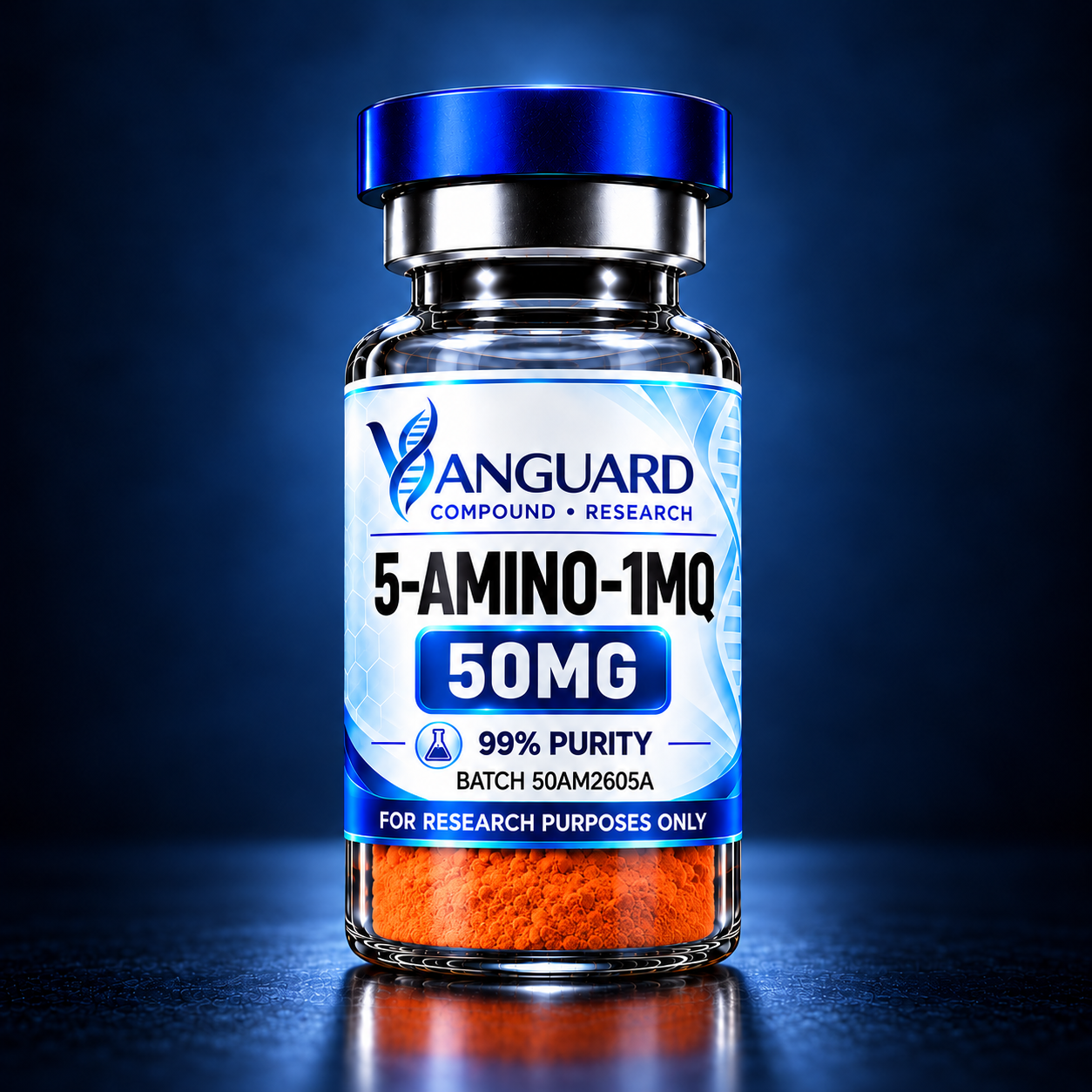
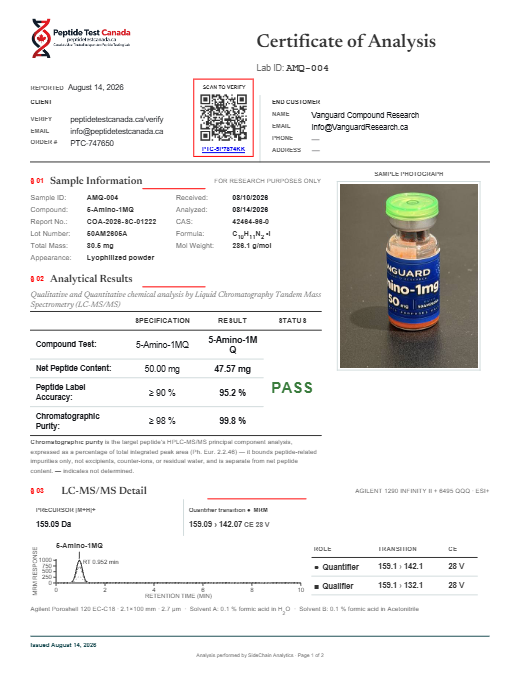
5-Amino-1MQ, formally known as 5-amino-1-methylquinolinium iodide, is an experimental small molecule used in laboratory studies of nicotinamide N-methyltransferase, or NNMT.
Although 5-Amino-1MQ is frequently discussed alongside peptides, it is not a peptide. Peptides consist of amino acids connected by peptide bonds. 5-Amino-1MQ instead has a compact quinolinium-based chemical structure with no amino-acid sequence.
Researchers are interested in the compound because NNMT participates in two important areas of cellular chemistry:
- Nicotinamide and NAD⁺ metabolism
- Methyl-donor metabolism involving S-adenosyl-L-methionine, or SAM
Published research has examined 5-Amino-1MQ in enzyme assays, cultured cells and animal models. These investigations help researchers understand NNMT biology, but they do not establish that the compound is safe or effective for people.
Understanding NNMT in simple terms
NNMT is an enzyme found in several tissues, including the liver, adipose tissue, skeletal muscle, kidneys and other organs. Its biological role can differ depending on the tissue and experimental condition.
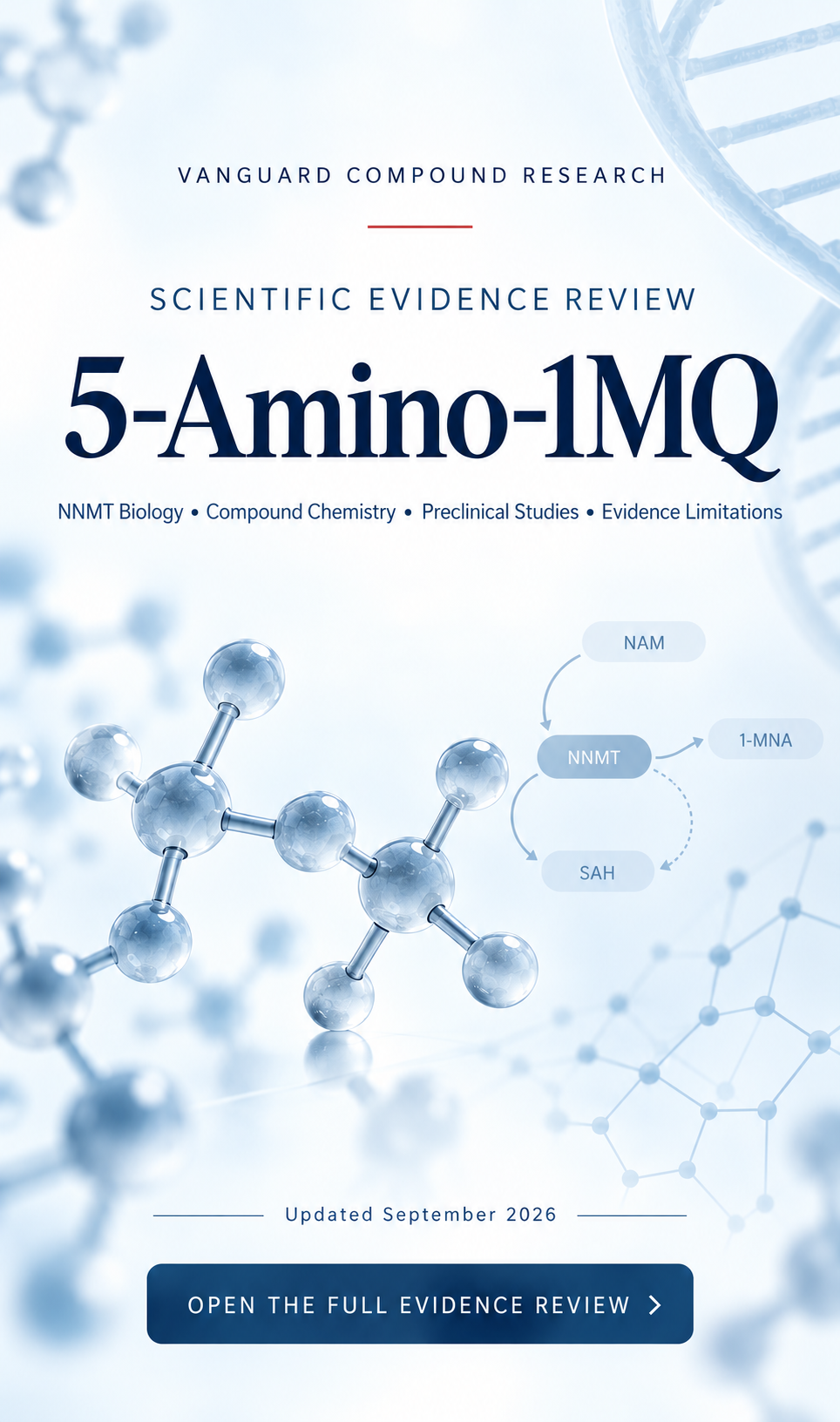
NNMT transfers a methyl group from SAM to nicotinamide:
Nicotinamide + SAM → 1-methylnicotinamide + SAH
Nicotinamide is a form of vitamin B3 and an important part of the cellular pathway used to regenerate NAD⁺. NAD⁺ is a naturally occurring coenzyme required for many cellular reactions involving energy transfer, metabolic regulation, DNA repair and cellular stress responses.
When NNMT methylates nicotinamide, it produces 1-methylnicotinamide, also called 1-MNA. This can reduce the amount of nicotinamide available to other pathways. At the same time, NNMT consumes SAM, one of the cell’s principal methyl-group donors.
NNMT does not directly destroy NAD⁺. Instead, it may influence how much nicotinamide remains available for NAD⁺ salvage and how cellular methyl donors are used.
How researchers investigate 5-Amino-1MQ
5-Amino-1MQ has been characterized as a substrate-site NNMT inhibitor. In laboratory terminology, an inhibitor is a compound that reduces the measured activity of an enzyme under defined experimental conditions.
The proposed research sequence is:
- 5-Amino-1MQ interacts with NNMT.
- NNMT-mediated methylation of nicotinamide decreases.
- Production of 1-methylnicotinamide may decline.
- More nicotinamide may remain available for other cellular pathways.
- NNMT-related consumption of SAM may also be reduced.
- These biochemical changes may influence downstream cellular activity.
A 2018 study reported an NNMT inhibitory concentration, or IC₅₀, of approximately 1.2 µM under the investigators’ assay conditions. IC₅₀ is a laboratory measurement describing the concentration associated with 50% inhibition in a particular assay. It is not a human dose and should not be converted into one.
Adipocyte and metabolic research
A 2014 study demonstrated that genetically reducing NNMT expression in the white adipose tissue and liver of mice affected SAM, NAD⁺ and cellular energy expenditure. This investigation helped establish NNMT as a metabolic research target, but it examined genetic NNMT reduction rather than administering 5-Amino-1MQ to humans. Kraus et al., 2014.
Researchers subsequently evaluated 5-Amino-1MQ directly. In differentiated adipocyte models, the compound produced concentration-dependent NNMT inhibition. The investigators also reported reductions in intracellular 1-MNA, changes in NAD⁺ availability and reduced lipid accumulation under their experimental conditions.
In diet-induced obese mice, an 11-day experiment reported changes in body weight, white-adipose-tissue mass and adipocyte size. These results were obtained in an animal model under controlled experimental conditions. They do not demonstrate weight-management effectiveness in people. Neelakantan et al., 2018.
Skeletal-muscle research
A 2019 study investigated NNMT inhibition in muscle stem cells obtained from aged experimental models. Researchers reported changes in muscle-cell proliferation, differentiation and fusion. The study also examined muscle regeneration following experimental injury in aged mice.
These observations have contributed to scientific interest in NNMT and age-related muscle biology. They do not demonstrate improved muscle growth, recovery or physical performance in people. Neelakantan et al., 2019.
A 2024 mouse study compared NNMT inhibition, exercise and a combination of both interventions. Researchers reported changes in grip strength and molecular pathways associated with muscle function. Because the study involved aged mice rather than people, the findings cannot establish a human exercise or muscle benefit. Dimet-Wiley et al., 2024.
Diet and microbiome research
Another mouse investigation examined NNMT inhibition alongside a reduced-calorie diet. Researchers evaluated adipose metabolites, body composition, liver-related measurements and intestinal microbiome patterns.
The compound and dietary intervention were studied together, meaning the reported results cannot necessarily be attributed to 5-Amino-1MQ alone. Microbiome findings from mice also cannot be assumed to occur in humans. Dimet-Wiley et al., 2022.
What might this research mean for humans?
NNMT is present in human tissues, making it a legitimate subject of human metabolic research. However, confirming that a pathway exists in humans is not the same as demonstrating that inhibiting it with 5-Amino-1MQ is safe or beneficial.
The current evidence supports studying questions such as:
- How NNMT regulates nicotinamide handling
- Whether NNMT activity affects intracellular NAD⁺ availability
- How NNMT participates in methyl-donor metabolism
- How changes in NNMT activity affect adipocyte development
- Whether NNMT influences muscle-cell differentiation and aging
- How NNMT activity differs across tissues and disease models
The evidence does not establish that consuming or administering 5-Amino-1MQ produces weight reduction, increased energy, improved insulin sensitivity, muscle preservation or anti-aging effects in people.
Important evidence limitations
The published research summarized here does not establish:
- Human safety or tolerability
- Human pharmacokinetics or bioavailability
- An appropriate human route of administration
- A safe or effective human dosage
- Human weight-management effectiveness
- Human muscle or exercise-performance benefits
- Long-term toxicity
- Reproductive or developmental safety
- Genotoxicity or carcinogenicity
- Interactions with medications, supplements or other compounds
- Safety of oral, injectable or other forms of human administration
Animal and cell-culture results frequently differ from human clinical outcomes. Experimental exposure levels should not be converted into human-use instructions.
Research status
5-Amino-1MQ remains an investigational research compound. It is not authorized by Health Canada as a therapeutic product and has no Health Canada-approved indication or established human dosage.
This material is supplied exclusively for controlled laboratory research. It is not intended to diagnose, treat, cure, prevent or reduce the risk of any disease or medical condition.
Not for human consumption, veterinary use, clinical use, compounding or administration to humans or animals.