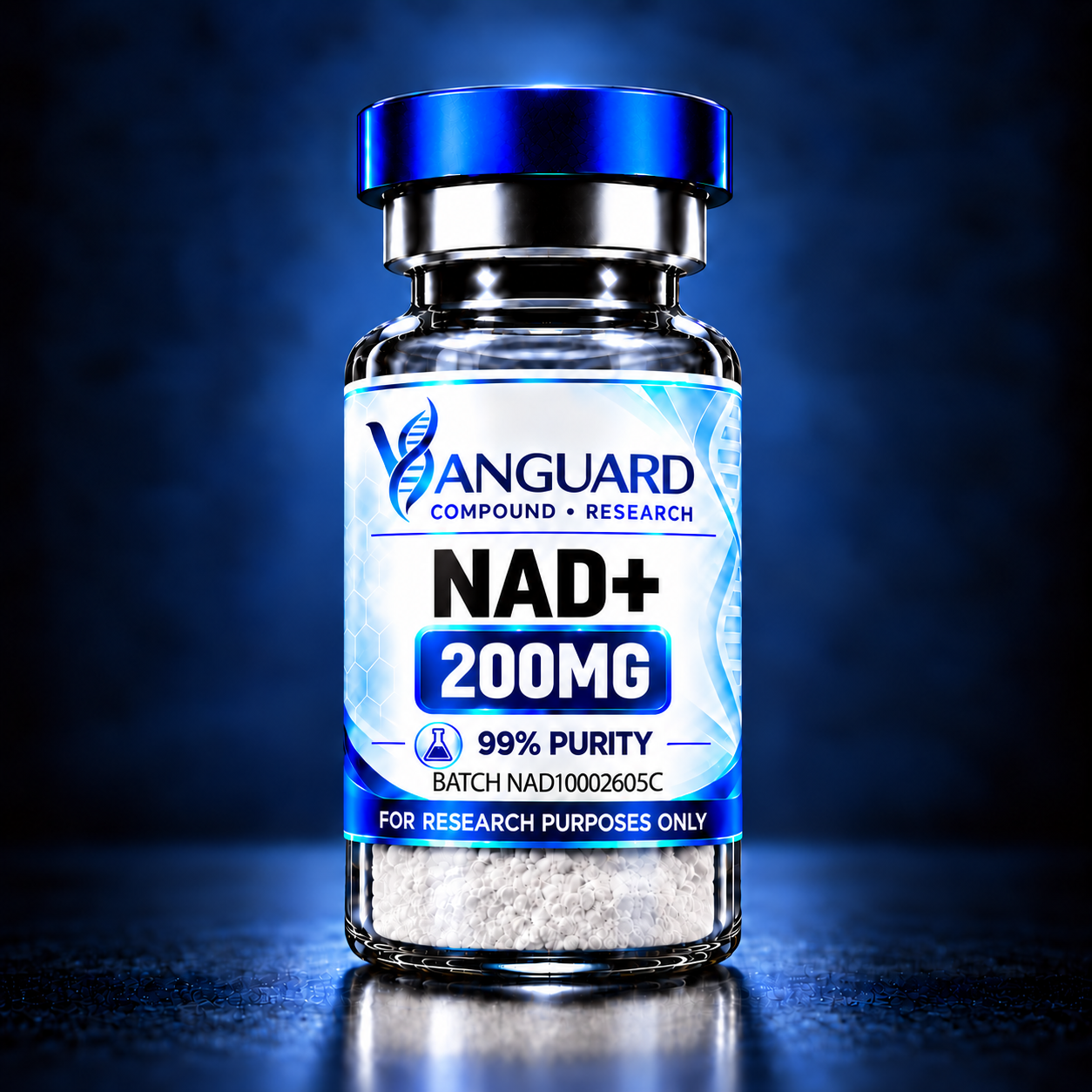
NAD+ (Nicotinamide Adenine Dinucleotide) is a naturally occurring coenzyme present in virtually all living cells and is essential to cellular energy metabolism, redox reactions and numerous enzyme-driven signalling pathways. Unlike peptide-based research compounds, NAD+ is a dinucleotide coenzyme that continuously cycles between its oxidized NAD+ and reduced NADH forms during cellular metabolism.
Research involving NAD+ focuses heavily on mitochondrial function, cellular energy production, metabolic regulation, DNA-repair pathways and NAD+-dependent enzymes including sirtuins and PARPs. Because cellular NAD+ availability changes with metabolic stress, aging and disease states, it has become an important research target in cellular metabolism and longevity biology.
This material is intended for laboratory research only, is not authorized by Health Canada for human therapeutic use, and is not intended for human or veterinary administration.
Choose a kit option to save more, or skip this and buy individually above.




*LC-MS identity confirmation may be performed when analytical review indicates conflicting, atypical, or inconclusive results.
NAD+ stands for Nicotinamide Adenine Dinucleotide, an essential coenzyme found throughout living cells.
It is not a peptide. Structurally, NAD+ is a dinucleotide composed of two nucleotide units connected through their phosphate groups. One contains an adenine base while the other contains nicotinamide, a vitamin B3-derived component.
NAD+ plays a central role in cellular metabolism because it functions both as an electron carrier in oxidation-reduction reactions and as a substrate for several important families of cellular enzymes.
Researchers study NAD+ across fields including mitochondrial biology, energy metabolism, cellular stress responses, DNA repair, metabolic regulation and aging-associated biology.
One of the best-established biological roles of NAD+ involves energy production.
During metabolic reactions, NAD+ accepts electrons and is converted into its reduced form, NADH. NADH can subsequently transfer those electrons into mitochondrial pathways involved in oxidative phosphorylation and ATP production.
This NAD+/NADH cycling occurs throughout major metabolic pathways including:
The ability to continuously move between oxidized and reduced states makes NAD+ fundamental to cellular energy transfer and maintenance of cellular redox balance.
Mitochondria depend heavily on NAD+/NADH chemistry for energy metabolism.
Within mitochondria, NADH generated from nutrient metabolism supplies electrons to the electron-transport chain, helping drive ATP production.
For this reason, NAD+ research frequently examines mitochondrial function, energy availability, metabolic flexibility and cellular responses to energetic stress.
NAD+ is distributed among several major cellular compartments, including the cytoplasm, nucleus and mitochondria, and the concentration and metabolism of NAD+ can be regulated independently within these compartments.
NAD+ also functions as an essential substrate for a family of enzymes known as sirtuins.
Mammals possess seven recognized sirtuins, commonly identified as SIRT1 through SIRT7. These enzymes participate in numerous regulatory processes involving metabolism, mitochondrial biology, cellular stress responses, gene regulation and protein modification.
Because sirtuin enzymatic activity depends on NAD+, researchers have investigated the relationship between cellular NAD+ availability and sirtuin-mediated signalling.
This connection has made NAD+ metabolism an important area of research involving cellular adaptation, metabolic stress and aging-associated biological changes.
NAD+ is also consumed by poly(ADP-ribose) polymerase enzymes, commonly known as PARPs.
Several PARP enzymes become activated in response to DNA damage and use NAD+ as a substrate during ADP-ribosylation reactions associated with DNA-damage signalling and repair.
This creates an important relationship between cellular NAD+ availability and genomic-maintenance pathways.
High levels of DNA damage can substantially increase NAD+ consumption through PARP activity, which is one reason researchers study NAD+ metabolism in relation to cellular stress, DNA repair and age-associated changes in cellular function.
NAD+ is not only recycled during metabolic oxidation-reduction reactions. Several enzyme systems actually consume NAD+ as a substrate.
Important NAD+-consuming enzyme families include:
These enzymes participate in processes ranging from protein regulation and DNA repair to calcium signalling and cellular stress responses.
Because NAD+ is continually synthesized, recycled and consumed, cells maintain tightly regulated NAD+ pools through multiple biosynthetic and salvage pathways.
Changes in NAD+ metabolism have become a major area of aging-related research.
Experimental studies have observed reductions in NAD+ availability in various tissues and models during aging and metabolic stress. Researchers therefore investigate whether changes in NAD+ metabolism contribute to alterations in mitochondrial activity, DNA-repair capacity, metabolic regulation and cellular signalling.
Much of the research examining enhancement of NAD+ biology has focused on NAD+ precursors such as nicotinamide riboside and nicotinamide mononucleotide, as well as enzymes involved in NAD+ synthesis and degradation.
Although this field is sometimes described broadly as "anti-aging" research, the scientific evidence is more accurately characterized as investigation into NAD+ metabolism and age-associated cellular biology. Evidence for specific longevity outcomes in humans remains considerably more limited than experimental mechanistic evidence.
Cells can produce NAD+ through several metabolic routes.
These include synthesis from tryptophan and salvage pathways involving vitamin B3-related molecules such as:
The salvage pathway is particularly important because NAD+ consumed by signalling enzymes can be recycled through nicotinamide and other intermediates.
This constant synthesis and recycling helps cells maintain sufficient NAD+ for metabolic and signalling requirements.
NAD+ is fundamentally different from the peptide compounds commonly investigated in biochemical research.
The commonly referenced NAD+ zwitterionic form has:
PubChem identifies this form as nadide, beta-NAD and coenzyme I.
Different protonation states, salts or hydrated forms can have different molecular formulas and molecular weights. Product specifications should therefore correspond to the exact chemical form confirmed by the applicable supplier documentation or analytical report.
NAD+ metabolism has been investigated extensively in humans, although an important distinction exists between research involving NAD+ itself and studies that attempt to increase endogenous NAD+ through precursor compounds such as NR or NMN.
Research continues to examine how NAD+ availability relates to energy metabolism, mitochondrial function, metabolic health, cellular stress and age-associated physiological changes.
Mechanistic evidence establishing NAD+'s essential role in cellular biology is extensive. Evidence supporting particular clinical outcomes from externally supplied NAD+, however, is much more limited and should not be considered equivalent to the extensive basic science surrounding endogenous NAD+ metabolism.
NAD+ is an essential naturally occurring cellular molecule, but this does not mean that every proposed intervention designed to increase NAD+ has demonstrated equivalent biological or clinical effects.
Studies involving NAD+ precursors, genetic manipulation of NAD+ pathways or direct NAD+ administration represent different experimental approaches and should not automatically be treated as interchangeable.
Research findings from cell culture and animal experiments also cannot automatically establish corresponding outcomes in humans.
Analytical purity likewise does not establish sterility, endotoxin status, total vial quantity or suitability for biological administration. These characteristics require separate analytical methods when applicable.
For laboratory research only. Not for human or veterinary use.
Product name: NAD+
Full name: Nicotinamide Adenine Dinucleotide
Alternative names: beta-NAD / Nadide / Coenzyme I
Compound type: Dinucleotide coenzyme
Research classification: Cellular metabolism and redox cofactor
Research category: Mitochondrial, metabolic, cellular-energy and NAD+-dependent signalling research
CAS number: 53-84-9
PubChem CID: 5892
Format: Lyophilized research material supplied in a sealed laboratory vial
Nominal strength: 600 mg per vial
Intended classification: Laboratory research reagent
Chemical class: Dinucleotide coenzyme
Molecular formula: C21H27N7O14P2
Molecular weight: Approximately 663.4 Da
Oxidation state: Oxidized NAD+
Reduced counterpart: NADH
Primary structural components: Nicotinamide nucleotide and adenine nucleotide joined through a pyrophosphate linkage
Peptide sequence: Not applicable — NAD+ is not a peptide
The molecular formula and molecular weight listed above correspond to the NAD+ zwitterionic form identified by PubChem CID 5892 and CAS 53-84-9. Alternative salts, hydrates and protonation states may have different molecular weights and formulas.
Physical form: Lyophilized powder
Typical appearance: White to off-white lyophilized material
Solubility: Water soluble
Presentation: Sealed laboratory vial
Nominal vial content: 600 mg
Physical appearance alone does not establish identity, purity or quantity.
Primary purity assessment: High-performance liquid chromatography (HPLC)
Identity assessment: Mass-spectrometric or other suitable analytical identity testing where performed
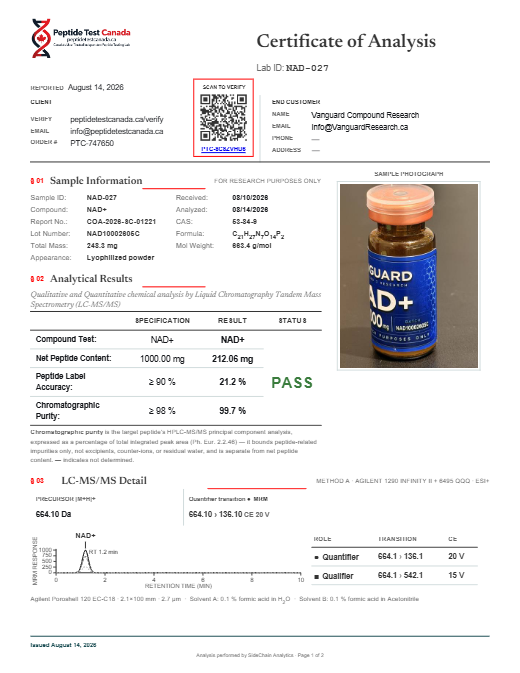
Purity reporting: Batch-specific analytical value
Quantity/content determination: Independently reported where quantitative content testing has been performed
Acceptance reporting: Based on analytical documentation applicable to the individual production batch
Chromatographic purity represents the relative purity of the analyzed compound and should not independently be interpreted as confirmation of total vial quantity, sterility or endotoxin status.
Each production batch should be identified using its individual lot or batch number and linked directly to corresponding analytical documentation.
Where performed, batch documentation may include:
Only analytical tests actually performed on the applicable batch should be represented as completed.
Sterility, endotoxin, microbial or pharmaceutical-quality characteristics should not be implied unless specifically evaluated using an appropriate validated analytical method.
Recommended storage: 2–8°C
Light exposure: Protect from unnecessary light exposure
Moisture: Maintain material in a sealed, dry environment
Container: Keep vial securely closed until required for laboratory analysis
Stability: Batch-specific stability should be based on applicable supplier or analytical documentation
Storage information relates solely to preservation of laboratory research material and does not constitute preparation or administration instructions.
NAD+ supplied under this specification is intended exclusively for:
Not for human consumption.
Not for human or veterinary use.
Not intended for diagnosis, treatment, cure or prevention of disease.
Not represented as sterile or suitable for injection unless such characteristics have been independently established through appropriate validated testing.
Product specifications describe the general molecular identity and research classification of NAD+.
Actual identity, purity, quantity and other analytical characteristics are batch-specific and should be determined from the Certificate of Analysis and supporting laboratory documentation applicable to the individual lot.
Published scientific literature concerning endogenous NAD+ biology, NAD+ precursors or experimental manipulation of NAD+ pathways should not be interpreted as analytical verification or clinical validation of independently supplied NAD+ research material.
For laboratory research only. Not for human or veterinary use.
No documents available for this product yet.
Additional documentation available upon request.
Each batch undergoes analytical review using validated laboratory procedures. HPLC testing is utilized to assess purity and compare the sample profile against established reference standards. Where additional verification is warranted, LC-MS analysis may be performed to support compound identity confirmation.
*See LC-MS Confirmation Information for full details.
Every batch supplied by Vanguard Compound Research is assigned a unique batch number and maintained under documented quality-control procedures with supporting analytical documentation available upon request.
All Vanguard Compound Research orders are shipped directly from within Canada, ensuring efficient delivery, reliable service, and consistent quality-control from fulfillment to arrival.
Products are maintained under documented quality-control procedures to help ensure quality, consistency, and transparency.
Each product is assigned a unique lot number, allowing researchers to match their item directly to its corresponding Certificate of Analysis (COA).
Supporting analytical documentation may be available for qualifying products, including batch-specific quality records and testing information.
Documentation may include: