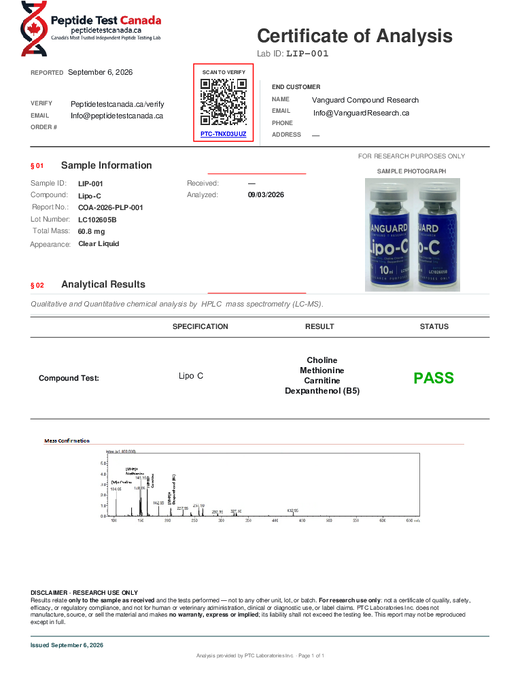
LIPO-C is a multi-component research formulation combining Choline, Methionine, Carnitine, and Dexpanthenol (Vitamin B5 precursor) in a clear liquid preparation. Each component contributes to distinct but interconnected biochemical pathways involved in lipid metabolism, cellular energy production, methyl-group transfer, and nutrient-dependent metabolic processes. Choline is widely studied for its role in phospholipid synthesis, membrane structure, methyl metabolism, and acetylcholine production. Methionine is an essential sulfur-containing amino acid that participates in the methionine cycle and the formation of S-adenosylmethionine (SAM), a major biological methyl donor. Carnitine is central to mitochondrial fatty-acid transport and is commonly researched in relation to beta-oxidation, energy metabolism, and cellular fuel utilization. Dexpanthenol is a precursor of pantothenic acid and supports research involving coenzyme A formation, acetyl-CoA metabolism, and numerous acyl-transfer reactions. Together, these four compounds provide a versatile formulation for investigating interconnected pathways related to mitochondrial function, lipid processing, methylation, amino-acid metabolism, and cellular energetics. This material is intended for laboratory research only, is not authorized by Health Canada for human therapeutic use, and is not intended for human or veterinary administration.
Choose a kit option to save more, or skip this and buy individually above.

*LC-MS identity confirmation may be performed when analytical review indicates conflicting, atypical, or inconclusive results.
LIPO-C is a multi-component research formulation combining Choline, Methionine, Carnitine, and Dexpanthenol (Vitamin B5 precursor). These four compounds participate in distinct but interconnected biochemical pathways involving lipid metabolism, methyl-group transfer, mitochondrial fatty-acid transport, coenzyme A formation, and cellular energy production.
Rather than acting through a single biochemical pathway, LIPO-C brings together compounds that are commonly studied across several areas of metabolic research. This makes the formulation useful for laboratory investigations focused on nutrient metabolism, cellular energetics, mitochondrial function, lipid processing, phospholipid synthesis, and amino-acid metabolism.
Choline is an essential nutrient-like compound involved in several fundamental biochemical processes. One of its best-known roles is its contribution to the synthesis of phosphatidylcholine, a major phospholipid found throughout biological cell membranes.
Phosphatidylcholine is important for maintaining membrane structure and participates in lipid transport and cellular signaling. Because of these functions, choline is frequently studied in research involving phospholipid metabolism, membrane biology, hepatic lipid handling, and cellular lipid transport.
Choline also contributes to methyl-group metabolism through its conversion to betaine. Betaine participates in the remethylation of homocysteine to methionine, creating an important biochemical connection between choline and methionine metabolism.
In addition, choline serves as a precursor for acetylcholine, an important neurotransmitter involved in cholinergic signaling. This makes choline relevant to research involving neuronal communication, phospholipid turnover, membrane organization, and cellular signaling pathways.
Methionine is an essential sulfur-containing amino acid involved in protein synthesis and numerous metabolic processes. It serves as the starting substrate for the formation of S-adenosylmethionine (SAM), one of the most important biological methyl donors.
SAM participates in a wide range of methylation reactions involving DNA, RNA, proteins, phospholipids, neurotransmitters, and other cellular molecules. For this reason, methionine is widely studied in research related to methylation biology, amino-acid metabolism, epigenetic processes, sulfur metabolism, and cellular regulation.
Methionine also participates in the methionine cycle, where it is converted through several intermediates before potentially being regenerated from homocysteine. This pathway connects methionine metabolism with choline-dependent methyl-donor systems.
Through the transsulfuration pathway, methionine metabolism is also linked with the production of sulfur-containing molecules and downstream cellular antioxidant systems. This makes methionine relevant to research examining metabolic balance, redox biology, and cellular nutrient processing.
Carnitine plays an important role in mitochondrial fatty-acid metabolism. Its primary biochemical function involves helping transport long-chain fatty-acid derivatives across the inner mitochondrial membrane.
Long-chain fatty acids require a specialized transport process before they can enter the mitochondrial matrix and undergo beta-oxidation. Carnitine participates in this transport system, often referred to as the carnitine shuttle.
Once transported into the mitochondria, fatty acids can be metabolized through beta-oxidation and contribute to cellular energy production. Because of this role, carnitine is extensively studied in research involving mitochondrial metabolism, fatty-acid utilization, energy production, and metabolic flexibility.
Carnitine is also relevant to investigations examining how cells regulate the balance between carbohydrate and lipid utilization under different metabolic conditions.
Dexpanthenol is an alcohol analogue of pantothenic acid, commonly known as Vitamin B5. Within biological systems, dexpanthenol can be converted into pantothenic acid, which is required for the synthesis of coenzyme A (CoA).
Coenzyme A is a central metabolic cofactor involved in numerous biochemical reactions. It plays a key role in the transfer of acyl groups and participates in pathways involving carbohydrates, fatty acids, amino acids, and other cellular metabolites.
One of the most important CoA-related molecules is acetyl-CoA, which serves as a major metabolic intersection between carbohydrate metabolism, fatty-acid metabolism, amino-acid metabolism, and mitochondrial energy production.
Because of this relationship, dexpanthenol is commonly studied in research related to CoA-dependent metabolism, cellular energy processing, fatty-acid metabolism, and acetyl-group transfer.
The scientific interest in LIPO-C comes from the way its individual components participate in overlapping areas of cellular metabolism.
Choline contributes to phospholipid synthesis, methyl metabolism, and acetylcholine production.
Methionine supports research involving the methionine cycle, SAM-dependent methylation, sulfur metabolism, and amino-acid pathways.
Carnitine is closely associated with mitochondrial fatty-acid transport and beta-oxidation.
Dexpanthenol contributes to research involving pantothenic acid, coenzyme A, acetyl-CoA, and broader cellular energy metabolism.
Together, these compounds provide a multi-pathway research formulation suitable for studying the relationship between nutrient-dependent metabolism, mitochondrial function, lipid utilization, methyl-group transfer, and cellular energy production.
LIPO-C is intended for laboratory research purposes only and is not intended for human or veterinary use.
Product Name: LIPO-C
Product Type: Multi-component metabolic research formulation
Form: Liquid preparation
Primary Components: Choline, Methionine, Carnitine, Dexpanthenol (B5)
Research Category: Metabolic and biochemical research
Intended Use: Laboratory research only
Compound Class: Essential nutrient / quaternary ammonium compound
Primary Biochemical Roles:
Primary Research Applications:
Key Biochemical Relationship:
Choline → Phosphatidylcholine / Betaine / Acetylcholine
Compound Class: Essential sulfur-containing amino acid
Primary Biochemical Roles:
Primary Research Applications:
Key Biochemical Relationship:
Methionine → S-adenosylmethionine (SAM) → Methyl-transfer reactions
Compound Class: Naturally occurring quaternary ammonium metabolite
Primary Biochemical Roles:
Primary Research Applications:
Key Biochemical Relationship:
Fatty Acids → Acyl-Carnitine → Mitochondrial Transport → Beta-Oxidation
Compound Class: Pantothenic-acid precursor
Primary Biochemical Roles:
Primary Research Applications:
Key Biochemical Relationship:
Dexpanthenol → Pantothenic Acid → Coenzyme A → Acyl-CoA / Acetyl-CoA
LIPO-C is particularly relevant to laboratory research involving:
Physical Form: Liquid
General Appearance: Clear liquid preparation
Composition: Multi-component solution
Container Format: Research vial
Reconstitution Required: No
Product State: Pre-formulated liquid
Because LIPO-C contains multiple individual compounds rather than a single molecular entity, the formulation should not be represented by one universal molecular formula or molecular weight.
LIPO-C is a combined formulation rather than a single chemical compound.
Each component possesses its own molecular structure, molecular weight, chemical characteristics, and biochemical properties. As a result, the finished formulation does not have one single:
Individual molecular specifications should therefore be considered separately for Choline, Methionine, Carnitine, and Dexpanthenol.
Analytical testing of multi-component formulations may involve methods selected according to the chemical characteristics of the individual ingredients.
Common analytical approaches may include:
Testing methodology can vary depending on the analytical laboratory, reference standards, target compounds, and study requirements.
Batch-specific analytical results should always be presented separately through the corresponding Certificate of Analysis rather than incorporated into the permanent product specifications.
LIPO-C should be handled using standard laboratory practices appropriate for research chemicals and multi-component liquid preparations.
Researchers should consider:
Any validated product-specific storage requirements should take precedence over general handling recommendations.
Store according to the labeled product requirements and applicable laboratory protocols.
General research handling considerations include:
Storage stability can vary depending on formulation, concentration, packaging, and environmental conditions.
Because LIPO-C contains multiple chemically distinct compounds, long-term stability may be influenced by:
Stability should therefore be assessed using formulation-specific analytical data when available.
Each production lot should be considered independently for quality-control purposes.
Where available, researchers should review the applicable batch-specific documentation, which may include:
This product page provides general compound information only and is intentionally independent of any individual lot, batch, analytical result, or testing date.
No documents available for this product yet.
Additional documentation available upon request.
Each batch undergoes analytical review using validated laboratory procedures. HPLC testing is utilized to assess purity and compare the sample profile against established reference standards. Where additional verification is warranted, LC-MS analysis may be performed to support compound identity confirmation.
*See LC-MS Confirmation Information for full details.
Every batch supplied by Vanguard Compound Research is assigned a unique batch number and maintained under documented quality-control procedures with supporting analytical documentation available upon request.
All Vanguard Compound Research orders are shipped directly from within Canada, ensuring efficient delivery, reliable service, and consistent quality-control from fulfillment to arrival.
Products are maintained under documented quality-control procedures to help ensure quality, consistency, and transparency.
Each product is assigned a unique lot number, allowing researchers to match their item directly to its corresponding Certificate of Analysis (COA).
Supporting analytical documentation may be available for qualifying products, including batch-specific quality records and testing information.
Documentation may include: