Glutathione
Overview
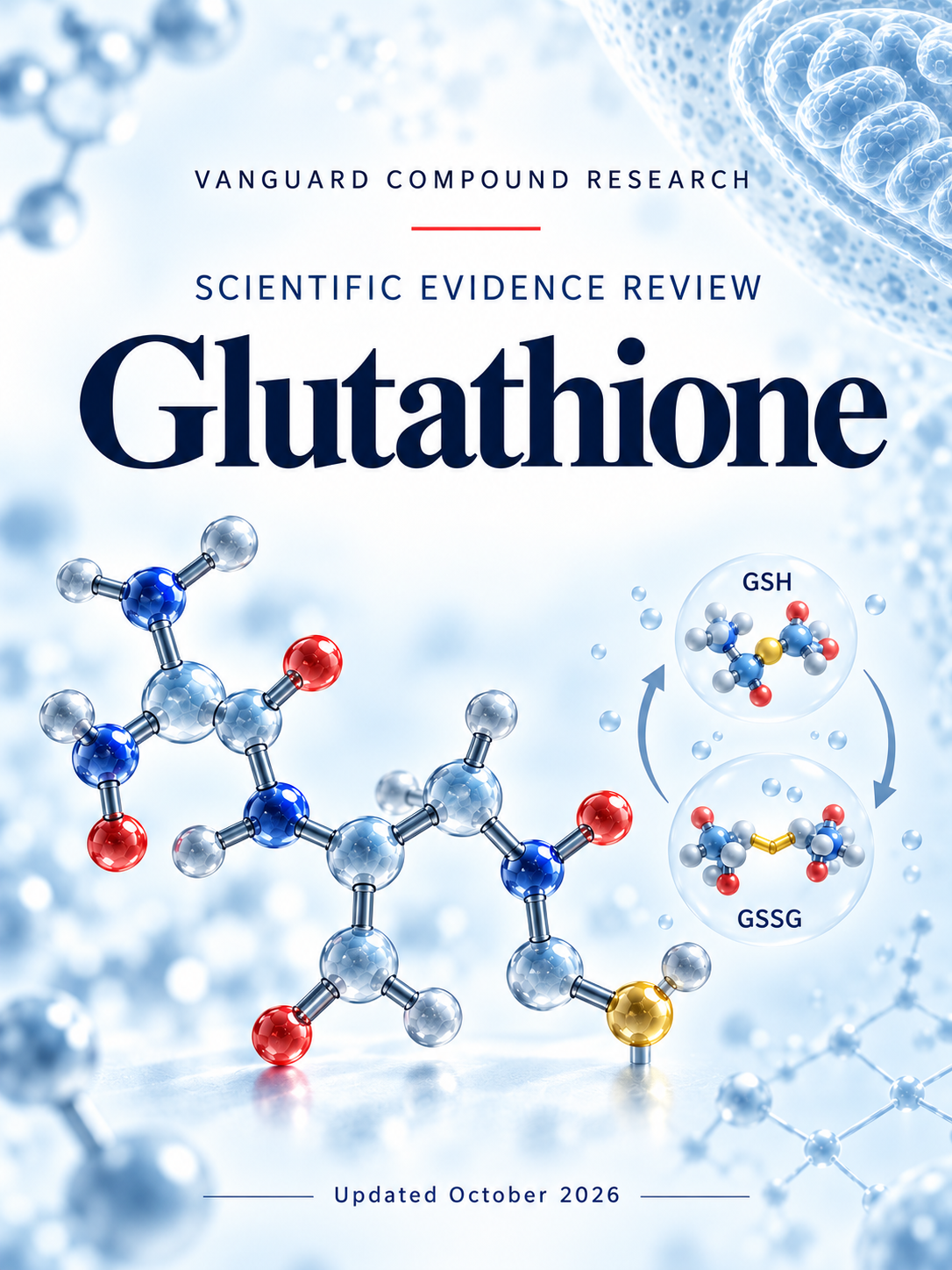
Glutathione, commonly abbreviated GSH, is a naturally occurring tripeptide constructed from three amino acids:
Glutamate + Cysteine + Glycine
Despite its relatively simple structure, glutathione is one of the most important intracellular molecules involved in maintaining normal cellular redox balance.
Unlike many antioxidant compounds obtained primarily from external sources, glutathione is synthesized within cells through an enzymatically regulated process. Its concentration and oxidation state can therefore provide researchers with valuable information about cellular metabolism, oxidative stress, mitochondrial function, and antioxidant capacity.
Glutathione is particularly important because it does not function in isolation. Instead, it forms part of a broad antioxidant and detoxification network involving enzymes, cofactors, cellular thiols, and metabolic pathways.
The Three Components of Glutathione
Glutamate
Glutamate forms one end of the glutathione molecule and participates in its unusual peptide structure.
In conventional peptides, amino acids are generally linked through the alpha-carboxyl group. Glutathione is different because glutamate forms a gamma-glutamyl bond with cysteine.
This structural feature helps distinguish glutathione from ordinary short peptides and contributes to its biological behavior.
Glutamate is also an important metabolic amino acid involved in:
- amino-acid metabolism;
- nitrogen handling;
- cellular energy pathways;
- neurotransmitter biology;
- glutamine metabolism;
- antioxidant synthesis.
Within glutathione research, glutamate is particularly important because availability of the necessary precursor amino acids can influence intracellular glutathione production.
Cysteine
Cysteine is generally considered the most chemically important component of glutathione's antioxidant activity.
Cysteine contains a sulfhydryl, or thiol (-SH), group.
This reactive sulfur-containing group allows glutathione to participate in oxidation-reduction reactions by donating electrons to oxidizing molecules.
During these reactions, reduced glutathione can be converted into its oxidized form.
Because cysteine availability can limit glutathione synthesis, cysteine metabolism is extensively investigated in studies involving:
- antioxidant capacity;
- oxidative stress;
- mitochondrial function;
- inflammatory signaling;
- detoxification;
- cellular injury.
The sulfur chemistry of cysteine is therefore central to understanding how glutathione works as a cellular redox molecule.
Glycine
Glycine is the third amino acid in glutathione.
Although glycine is structurally simple, it contributes to the completion and stability of the glutathione molecule.
Glycine also participates broadly in:
- protein synthesis;
- collagen metabolism;
- one-carbon metabolism;
- neurotransmission;
- cellular methylation pathways;
- metabolic regulation.
Research into glutathione synthesis has also examined whether glycine availability can become limiting under certain physiological or experimental conditions.
For this reason, glutathione biology is not solely dependent on cysteine; adequate precursor availability across all three constituent amino acids can influence intracellular production.
Reduced Glutathione — GSH
The biologically reduced form of glutathione is commonly abbreviated GSH.
This form contains an available thiol group capable of participating in oxidation-reduction reactions.
GSH is widely used in laboratory research as a marker and regulator of cellular antioxidant capacity.
Researchers commonly study GSH in relation to:
- reactive oxygen species;
- hydrogen peroxide metabolism;
- mitochondrial oxidative stress;
- lipid oxidation;
- cellular injury;
- redox signaling;
- antioxidant enzyme activity.
When glutathione participates in antioxidant reactions, GSH can be converted into oxidized glutathione.
Oxidized Glutathione — GSSG
The oxidized form of glutathione is commonly abbreviated GSSG.
During an oxidative reaction, two glutathione molecules can become linked through a disulfide bond.
Cells contain mechanisms capable of converting oxidized glutathione back into reduced glutathione.
This recycling system allows glutathione to function continuously as part of the intracellular antioxidant network.
The relationship between:
GSH ↔ GSSG
is therefore an important research indicator of cellular redox conditions.
Researchers frequently examine the GSH:GSSG ratio as an experimental marker of oxidative stress.
A shift toward greater oxidation may indicate increased oxidative burden or impaired antioxidant recycling.
Antioxidant Research
Glutathione is one of the most extensively investigated molecules in antioxidant biology.
Normal cellular metabolism generates reactive oxygen species.
At controlled levels, these molecules can participate in normal signaling.
When excessive reactive oxygen species accumulate, however, they can contribute to oxidative damage involving:
- proteins;
- cellular membranes;
- DNA;
- mitochondria;
- lipids.
Glutathione helps maintain redox balance by participating directly and indirectly in antioxidant reactions.
Research commonly examines whether changes in glutathione concentration correspond with oxidative cellular injury.
Glutathione Peroxidase Research
One of glutathione's most important biological partnerships is with the enzyme glutathione peroxidase.
Glutathione peroxidase uses reduced glutathione as a substrate when reducing certain peroxides.
A simplified research pathway can be represented as:
Peroxide + GSH → reduced peroxide product + GSSG
This pathway is particularly important in the regulation of hydrogen peroxide and lipid hydroperoxides.
Because excessive peroxide accumulation can damage cellular structures, glutathione-peroxidase activity is frequently studied in:
- oxidative-stress models;
- mitochondrial research;
- lipid-peroxidation studies;
- cellular aging;
- inflammatory biology.
Glutathione Reductase and Recycling
Once glutathione becomes oxidized, cells can regenerate reduced glutathione using the enzyme glutathione reductase.
This process relies on reducing equivalents, particularly NADPH.
The cycle can be represented conceptually as:
GSH → oxidation → GSSG → reduction → GSH
This continuous recycling process allows cellular glutathione pools to remain functional.
Researchers therefore often examine glutathione metabolism alongside:
- NADPH production;
- pentose-phosphate metabolism;
- mitochondrial activity;
- antioxidant enzyme systems.
Detoxification Research
Glutathione is also central to cellular detoxification pathways.
A family of enzymes known as glutathione S-transferases can attach glutathione to certain electrophilic compounds.
This process, known as glutathione conjugation, can increase the ability of cells to process and eliminate reactive compounds.
Research applications include studies involving:
- xenobiotic metabolism;
- environmental chemicals;
- drug metabolism;
- reactive metabolites;
- cellular detoxification pathways.
Glutathione therefore functions not only as an antioxidant but also as a biochemical substrate used by cellular detoxification systems.
Liver Research
The liver plays a particularly important role in glutathione metabolism.
Hepatic cells maintain substantial glutathione pools because the liver is heavily involved in metabolism and detoxification.
Glutathione research involving liver models commonly examines:
- oxidative liver stress;
- xenobiotic metabolism;
- reactive metabolites;
- mitochondrial function;
- cellular detoxification;
- hepatic antioxidant capacity.
Changes in hepatic glutathione may occur when oxidative burden exceeds the cell's ability to synthesize or regenerate reduced glutathione.
Mitochondrial Research
Mitochondria continuously generate reactive oxygen species as a consequence of cellular energy production.
For this reason, antioxidant regulation is particularly important within mitochondrial environments.
Glutathione research involving mitochondria includes investigation of:
- mitochondrial oxidative stress;
- respiratory-chain function;
- membrane integrity;
- cellular energy metabolism;
- mitochondrial damage;
- programmed cell-death pathways.
Maintaining adequate mitochondrial glutathione is therefore considered an important component of normal cellular antioxidant defense.
Cellular Aging Research
Oxidative stress and declining cellular maintenance mechanisms are extensively studied in aging research.
Glutathione levels and redox status may change with age, making the molecule relevant to investigations involving cellular aging.
Researchers may examine relationships between glutathione status and:
- mitochondrial function;
- oxidative DNA damage;
- protein oxidation;
- cellular senescence;
- metabolic function;
- antioxidant enzyme activity.
Glutathione is therefore frequently used as both a biological molecule of interest and an experimental marker in longevity-related research.
Immune-System Research
Glutathione metabolism also plays an important role in immune-cell biology.
Immune cells can generate reactive oxygen species as part of normal defensive signaling.
These cells therefore require tightly controlled antioxidant systems to prevent excessive self-damage.
Glutathione research involving immune cells may examine:
- lymphocyte function;
- macrophage activity;
- inflammatory signaling;
- oxidative burst regulation;
- intracellular redox signaling.
The relationship between oxidative signaling and antioxidant capacity is an important component of modern immunological research.
Inflammatory Research
Inflammation and oxidative stress frequently occur together.
Reactive oxygen species can influence inflammatory signaling pathways, while inflammatory processes can themselves increase oxidative activity.
Glutathione is therefore often studied in models involving:
- inflammatory cytokine signaling;
- oxidative stress;
- cellular injury;
- immune activation;
- tissue inflammation.
Rather than functioning as a single-target anti-inflammatory molecule, glutathione forms part of the cellular environment that helps regulate oxidative and inflammatory signaling.
Neurological Research
The nervous system has substantial energy requirements and can be particularly sensitive to oxidative stress.
Glutathione research involving neurological systems examines:
- neuronal oxidative stress;
- mitochondrial function;
- glial-cell biology;
- neurotransmitter metabolism;
- neuroinflammation;
- cellular redox regulation.
Brain glutathione metabolism continues to be an active area of scientific investigation because altered antioxidant balance has been observed in numerous neurological research models.
Such associations do not by themselves establish therapeutic efficacy.
Redox Signaling
Glutathione is not simply a molecule that removes oxidants.
Modern research increasingly recognizes that oxidation and reduction reactions are part of normal cellular signaling.
Certain proteins contain thiol groups whose activity can change depending on the cellular redox environment.
Glutathione can participate in these processes through mechanisms including S-glutathionylation, in which glutathione becomes temporarily attached to protein thiol groups.
This allows researchers to investigate glutathione as an active component of cellular signaling rather than only as a passive antioxidant.