Adipotide Product Specifications
Product identification
Adipotide is a synthetic targeted peptide construct developed for experimental research involving adipose-tissue vasculature. Its structure combines the CKGGRAKDC targeting sequence with a pro-apoptotic D-amino-acid peptide sequence. In preclinical research, the targeting portion has been investigated for its interaction with prohibitin associated with white-adipose-tissue vasculature.
- Product name: Adipotide
- Full descriptive name: CKGGRAKDC-GG-D(KLAKLAK)₂
- Common names: Adipotide
- Research designation: Adipose-targeting pro-apoptotic peptide
- Sequence: CKGGRAKDCGGKLAKLAKKLAKLAK
- Peptide length: 25 amino-acid residues
- Chemical class: Synthetic targeted peptide / peptidomimetic
- Targeting sequence: CKGGRAKDC
- Experimental molecular target: Prohibitin associated with adipose vasculature
- CAS number: 859216-15-2
- PubChem CID: 163360068
- Molecular formula: C₁₁₁H₂₀₆N₃₆O₂₈S₂
- Molecular weight: Approximately 2557.2 g/mol
- Appearance: White to off-white dried peptide material; actual appearance may vary by formulation and batch
- Solubility: Dependent on concentration, pH, formulation and supplied chemical form
- Available nominal strength: 5 mg per vial
- Format: Lyophilized research material in a sealed vial
- Intended classification: Laboratory research material
The molecular formula, molecular weight and sequence above describe the Adipotide structure catalogued by PubChem. The C-terminal portion contains D-amino-acid residues, which are an important feature of the defined molecule and should be considered when establishing analytical identity.
Molecular structure and composition
Adipotide consists of two functional peptide regions connected through a glycine-glycine spacer. The N-terminal CKGGRAKDC sequence functions as the targeting component and has been investigated for recognition of prohibitin associated with the vasculature of white adipose tissue. The second portion contains the pro-apoptotic sequence D(KLAKLAK)₂, constructed using D-amino-acid residues.
The complete reported sequence is CKGGRAKDCGGKLAKLAKKLAKLAK. PubChem identifies the first eleven residues as L-amino acids or glycine, followed by a fourteen-residue D-amino-acid segment.
- Targeting region: CKGGRAKDC
- Linker region: GG
- Effector region: D(KLAKLAK)₂
- Total peptide length: 25 residues
- Molecular formula: C₁₁₁H₂₀₆N₃₆O₂₈S₂
- Average molecular weight: Approximately 2557.2 g/mol
- Exact mass: Approximately 2556.53 Da
- Structural feature: Contains both L- and D-amino-acid residues
- Disulfide status: The two cysteine residues are represented as free thiol-containing residues in the PubChem canonical structure
These molecular values describe the reference structure and should not by themselves be interpreted as confirmation of the composition of an individual vial. Identity, peptide quantity, counterions, water content and other material characteristics require appropriate batch-specific analysis.
Physical specifications
- Physical state: Solid research material
- Typical presentation: Dried or lyophilized material in a sealed vial
- Typical colour: White to off-white; actual appearance may vary by manufacturing process and formulation
- Nominal fill: As stated on the product label and applicable batch record
- Current nominal strength: 5 mg
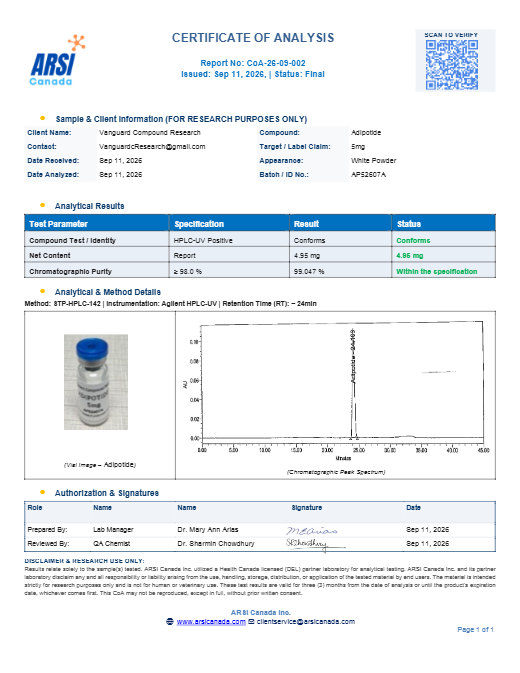
- Current batch: AP52607A
- Purity statement: Report only the result supported by the applicable batch analysis
- Peptide content: Batch-specific; requires quantitative analysis for confirmation
- Counterion content: Not established unless specifically measured
- Water content: Not established unless specifically measured
- Solvent or diluent included: None unless expressly listed
- Sterility status: Not tested unless supported by validated batch-specific testing
- Endotoxin status: Not tested unless supported by validated batch-specific testing
- Injectable preparation: No
- Pharmaceutical dosage form: No
- Finished therapeutic product: No
The term “lyophilized” should be used only where freeze-drying is confirmed by the manufacturer or applicable batch documentation. Powder appearance or cake size cannot establish peptide identity, purity, quantity, sterility or endotoxin status.
Analytical specifications
Chromatographic purity: High-performance liquid chromatography or LC-MS chromatography may be used to separate the principal peptide-related component from detectable impurities under a defined analytical method. The resulting purity percentage is generally a relative chromatographic measurement and should not automatically be interpreted as total active-peptide content by weight.
Appropriate chromatographic documentation should identify the product, batch number, sample-preparation procedure, analytical method, column or separation system, mobile-phase conditions, detection method, principal peak, calculated purity, analysis date and laboratory authorization.
Identity assessment: Mass spectrometry can support identification by comparing experimentally measured molecular ions with the expected molecular mass of Adipotide. The expected average molecular weight of the reference structure is approximately 2557.2 g/mol.
Sequence and stereochemistry: Standard molecular-mass analysis can support molecular identity but does not necessarily establish every stereochemical feature of a complex peptide. Because the Adipotide reference structure contains a substantial D-amino-acid segment, analytical conclusions should be limited to what the individual testing method can establish.
Depending on the research application, a broader analytical package may include:
- HPLC or UPLC for peptide-related purity
- LC-MS or high-resolution MS for molecular identity
- Quantitative peptide assay against an appropriate reference standard
- Peptide-mapping or sequence-confirmation procedures
- Water-content testing
- Residual-solvent analysis
- Counterion assessment
- Gravimetric or quantitative fill verification
- Additional structural analysis when stereochemical confirmation is required
Only analyses completed for the applicable batch should be presented as verified product attributes.
Batch-testing information
Batch-specific analytical information should be reported only from documentation corresponding directly to the material being offered.
- Current product: Adipotide
- Nominal strength: 5 mg
- Batch number: AP52607A
- Chromatographic purity: Report according to the applicable Certificate of Analysis
- Molecular identity: Report according to the applicable Certificate of Analysis
- Measured peptide content: Report only where quantitative testing has been performed
- Water content: Not established unless reported
- Residual solvents: Not established unless reported
- Counterion content: Not established unless reported
- Sterility: Not tested unless supported by batch-specific testing
- Endotoxin: Not tested unless supported by batch-specific testing
- Microbial limits: Not tested unless supported by batch-specific testing
Chromatographic purity, molecular identity, measured peptide content and total lyophilized material are separate analytical measurements. A chromatographic purity percentage should not be multiplied by the total weight of dried material and presented as confirmed Adipotide quantity unless the analytical method and quantitative assay support that calculation.
Storage specifications
Keep the unopened material in its original sealed container, protected from direct light and moisture. Use the storage temperature supported by supplier documentation or stability information for the applicable batch rather than assuming a validated storage condition where one has not been established.
- Keep the container sealed during storage
- Protect the material from direct light and moisture
- Avoid repeated temperature changes
- Minimize unnecessary exposure to ambient humidity
- Prevent contamination during laboratory handling
- Do not assume stability after opening, transfer or preparation
If cold storage is specified in qualified product documentation, allow the sealed container to approach the intended laboratory handling temperature before opening when condensation is a concern. Any expiry or retest date should be supported by manufacturer documentation or appropriate stability data.
Intended use and restrictions
This product is supplied exclusively as a laboratory research material. It is not manufactured or released as a sterile drug product, injectable preparation, food, dietary supplement, natural health product, veterinary product or finished therapeutic product.
It is not intended for:
- Human consumption or administration
- Veterinary administration
- Injection or compounding
- Diagnosis, treatment, mitigation or prevention of disease
- Food or beverage use
- Household use
No human dosage, administration route, reconstitution schedule or treatment protocol is provided. Published laboratory and animal findings involving Adipotide do not establish the safety or effectiveness of this independently supplied research material in humans.
Documentation notice
These specifications describe the general identity, physical characteristics, analytical boundaries and intended research classification of Adipotide. Final release information must be based on the Certificate of Analysis and manufacturing documentation for the specific batch.
Where general product information and batch-specific documentation differ, the discrepancy should be resolved before publication or research use. Customers should review the applicable analytical records before beginning laboratory work. A Certificate of Analysis reports only the sample and tests described; it is not evidence of regulatory authorization, clinical safety or therapeutic effectiveness.