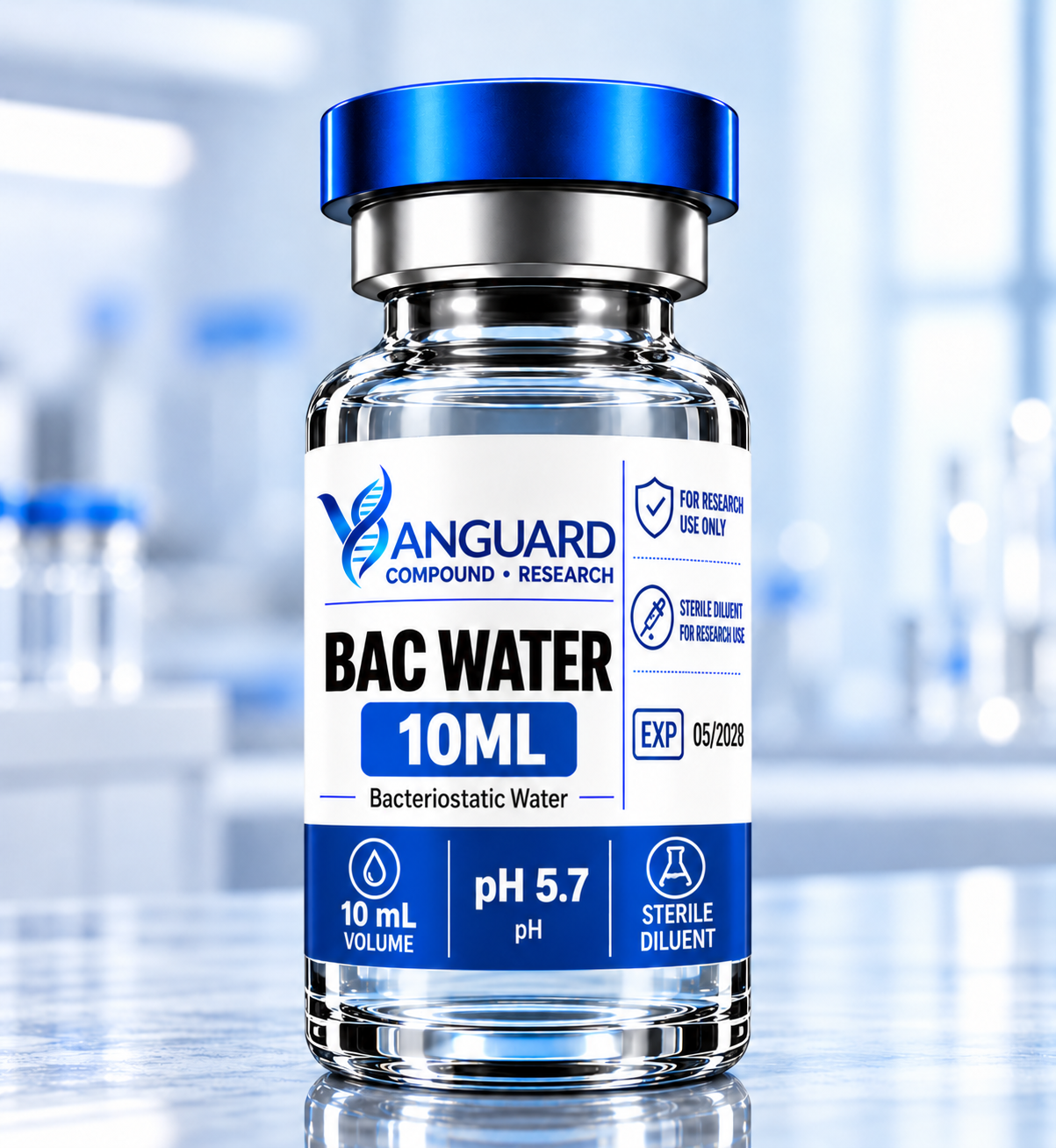
Bacteriostatic Water is a sterile, preservative-containing water solution commonly used as a laboratory diluent for reconstitution and preparation of research compounds. It contains benzyl alcohol, which helps limit bacterial growth after initial vial access and supports controlled multi-use handling under appropriate laboratory conditions. The clear, colorless solution is supplied in a sealed vial for convenient storage and handling. It is formulated to provide a consistent diluent for research applications requiring precise solution preparation. Store according to the conditions stated on the product label and maintain proper aseptic handling practices. Intended for laboratory and research use only. Not for human use.

*LC-MS identity confirmation may be performed when analytical review indicates conflicting, atypical, or inconclusive results.
Bacteriostatic Water is a sterile aqueous solution designed for use as a diluent when preparing, reconstituting, or handling compounds that require dissolution before laboratory analysis or research use. It is especially useful with lyophilized materials, where a dry powdered compound must first be returned to solution before it can be accurately measured, transferred, diluted, or incorporated into an experimental protocol.
Unlike plain sterile water, bacteriostatic water contains a small amount of benzyl alcohol, which acts as a bacteriostatic preservative. This preservative helps inhibit the growth of many common bacteria after the vial has been accessed. Because of this characteristic, bacteriostatic water is often chosen for laboratory workflows where a diluent vial may be accessed more than once while maintaining appropriate aseptic handling procedures.
One of its primary research applications is the reconstitution of lyophilized compounds. Freeze-dried materials are commonly supplied in powder or cake form to improve stability during storage and transportation. Before these materials can be used in solution-based laboratory procedures, an appropriate volume of diluent is introduced into the vial. Bacteriostatic water provides a clear, consistent aqueous medium that allows the compound to dissolve and form a usable research solution.
The amount of bacteriostatic water added during reconstitution directly affects the final concentration of the prepared solution. Researchers can therefore select an appropriate diluent volume based on the required working concentration, assay design, analytical method, or experimental protocol. Accurate measurement is important because concentration calculations depend on both the total amount of compound present and the final volume of solution.
Bacteriostatic water may also be used for serial dilution, sample preparation, concentration adjustment, and other laboratory procedures where a sterile aqueous diluent is appropriate. Its simple formulation makes it useful across a wide range of research environments, provided the compound being studied is chemically compatible with water and with the preservative present in the solution.
Proper aseptic technique remains important whenever bacteriostatic water is handled. Vial closures, transfer equipment, syringes, pipettes, and laboratory surfaces should be handled in a manner that minimizes contamination. The presence of benzyl alcohol helps suppress bacterial growth, but it does not replace good laboratory hygiene or sterile handling practices.
When reconstituting delicate research materials, the diluent is generally introduced carefully to reduce unnecessary agitation, foaming, or mechanical stress. Some compounds can be sensitive to vigorous mixing, so researchers should follow the handling and reconstitution recommendations appropriate to the specific material being studied.
Compatibility should always be considered before selecting bacteriostatic water as a diluent. Not every compound is best prepared in bacteriostatic water, and some research materials may require sterile water, saline, buffered solutions, acidic or alkaline media, or other specialized solvents. Solubility, pH, molecular stability, preservative compatibility, and the intended analytical method should all be considered.
Once a research compound has been reconstituted, storage conditions may differ substantially from those of the original dry material. Stability can be affected by temperature, light exposure, concentration, pH, microbial contamination, and the chemical characteristics of the compound. Researchers should therefore follow compound-specific storage information whenever available rather than assuming that every reconstituted material has the same stability profile.
Bacteriostatic Water is valued in research settings because it provides a convenient and consistent medium for solution preparation while offering added protection against bacterial proliferation after vial access. It is particularly suited to controlled laboratory environments where accurate concentration, clean handling, and repeatable sample preparation are important.
This product is intended strictly for laboratory and research applications. It should be used only by individuals familiar with proper laboratory handling, dilution calculations, compatibility assessment, and aseptic technique. Not for human use.
Product Name: Bacteriostatic Water
Format: Sterile aqueous solution
Fill Volume: 3 ML and 10 mL per vial
Primary Use: Laboratory diluent for the preparation, reconstitution, and dilution of compatible research compounds
Active Preservative: Benzyl alcohol
Appearance: Clear, colorless liquid
Solution Type: Preserved sterile water
Intended Application: Suitable for controlled laboratory procedures requiring an aqueous diluent, including the preparation of lyophilized materials, concentration adjustment, sample dilution, and general research solution preparation.
Preservative Function: Benzyl alcohol is included to help inhibit the growth of many common bacteria following initial vial access. The preservative does not replace proper aseptic handling or contamination-control procedures.
Reconstitution Compatibility: May be appropriate for research compounds that are soluble and chemically stable in aqueous solution containing benzyl alcohol. Compatibility should be confirmed for each specific material before use.
Concentration Control: The volume of bacteriostatic water used during preparation determines the final concentration of the reconstituted research solution. Accurate volumetric measurement is recommended for reproducible laboratory work.
Handling Requirements: Use clean, sterile transfer equipment and appropriate aseptic laboratory technique. Avoid unnecessary contact with the vial closure or solution.
Mixing Guidance: When used with sensitive lyophilized materials, introduce the solution carefully and avoid excessive shaking or agitation unless the compound-specific protocol states otherwise.
Storage: Store according to the temperature conditions stated on the product label. Protect the vial from contamination and excessive heat.
Post-Access Handling: Maintain appropriate aseptic technique after first access. The presence of a bacteriostatic preservative is intended to reduce bacterial proliferation but does not guarantee sterility after improper handling.
Container: Sealed multi-dose style vial
Research Classification: Laboratory and research-use product
Human Use Status: Not for human use
Important Compatibility Note: Bacteriostatic water is not universally suitable for every research compound. Some materials may require sterile water, saline, buffered media, or another specialized solvent depending on solubility, pH, stability, and analytical requirements.
No documents available for this product yet.
Additional documentation available upon request.
Each batch undergoes analytical review using validated laboratory procedures. HPLC testing is utilized to assess purity and compare the sample profile against established reference standards. Where additional verification is warranted, LC-MS analysis may be performed to support compound identity confirmation.
*See LC-MS Confirmation Information for full details.
Every batch supplied by Vanguard Compound Research is assigned a unique batch number and maintained under documented quality-control procedures with supporting analytical documentation available upon request.
All Vanguard Compound Research orders are shipped directly from within Canada, ensuring efficient delivery, reliable service, and consistent quality-control from fulfillment to arrival.
Products are maintained under documented quality-control procedures to help ensure quality, consistency, and transparency.
Each product is assigned a unique lot number, allowing researchers to match their item directly to its corresponding Certificate of Analysis (COA).
Supporting analytical documentation may be available for qualifying products, including batch-specific quality records and testing information.
Documentation may include: