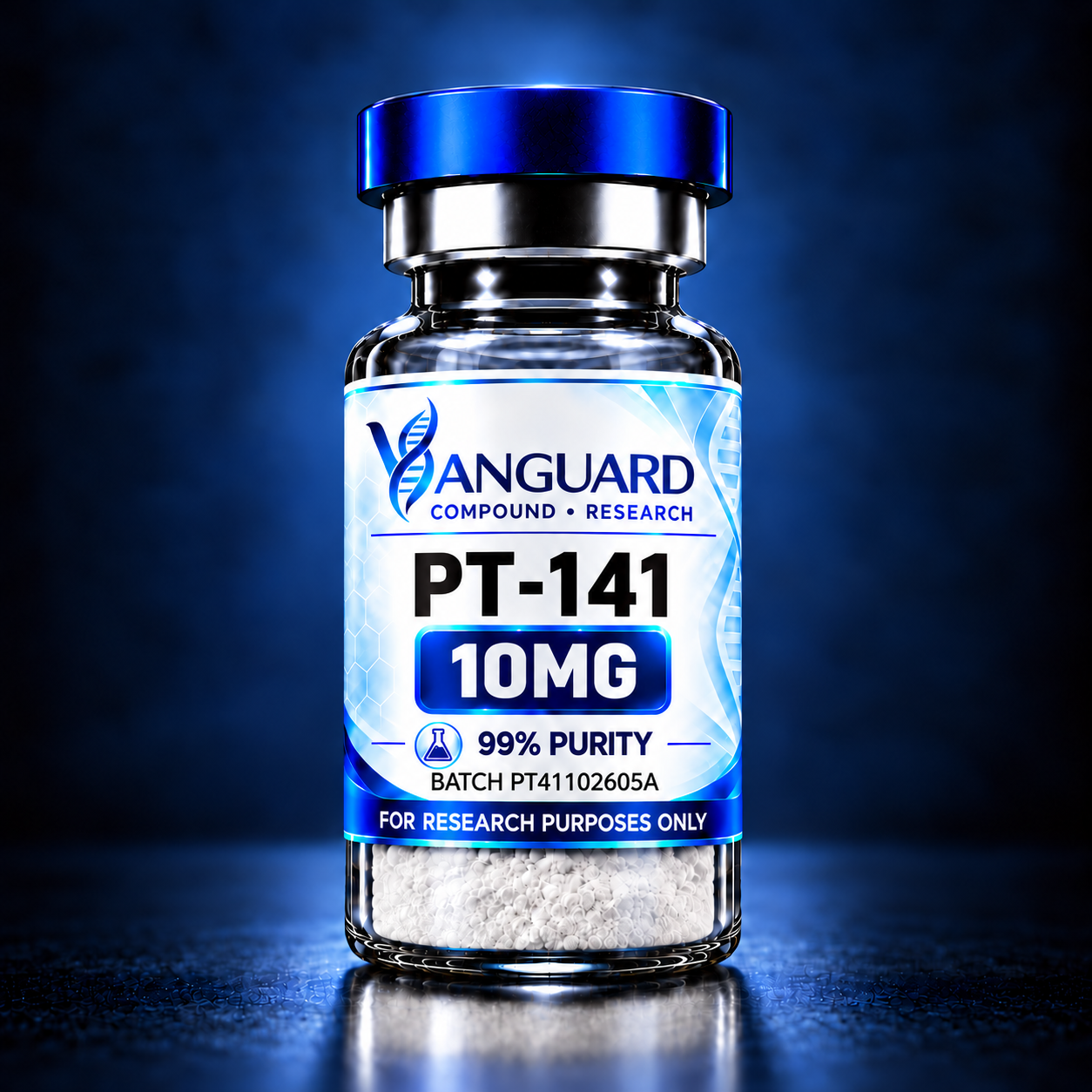
Epithalon, also commonly written as Epitalon, is a synthetic tetrapeptide composed of four amino-acid residues and widely investigated in aging, cellular regulation, circadian biology, oxidative stress, and longevity-related research. It was developed from research into peptide compounds associated with the pineal gland and age-related biological regulation. Epithalon has attracted particular scientific interest because of experimental work examining telomerase activity, telomere biology, cellular senescence, and gene-expression pathways associated with aging. Research has also explored its potential influence on melatonin production, sleep-wake regulation, antioxidant defenses, and cellular responses to oxidative stress. Additional studies have investigated its effects on neuroendocrine function and age-associated physiological changes. Because many of these pathways are interconnected, Epithalon is frequently used in experimental models examining how cellular aging affects multiple biological systems rather than a single isolated mechanism. The compound remains investigational, and much of the available research is preclinical or derived from relatively small studies. This material is intended for laboratory research only, is not authorized by Health Canada for human therapeutic use, and is not intended for human or veterinary administration.
Choose a kit option to save more, or skip this and buy individually above.


*LC-MS identity confirmation may be performed when analytical review indicates conflicting, atypical, or inconclusive results.
Epithalon, frequently referred to in scientific literature as Epitalon, is a synthetic tetrapeptide associated with research into aging, cellular longevity, neuroendocrine regulation, circadian rhythms, oxidative stress, and genomic stability.
The peptide consists of a short four-amino-acid sequence commonly represented as Ala-Glu-Asp-Gly (AEDG). Its small molecular structure has made it useful for studying biological signaling mechanisms associated with cellular aging and regulatory peptide activity.
Epithalon is supplied in this format as a 50 mg lyophilized peptide preparation. The compound has the molecular formula C₁₄H₂₂N₄O₉, a molecular weight of approximately 390.1 g/mol, and CAS number 307297-39-8. The supplied material is described as lyophilized powder. Epitalon 50mg
One of the best-known areas of Epithalon research involves telomeres and telomerase.
Telomeres are protective structures located at the ends of chromosomes. They help maintain chromosome stability during cellular replication. In many normal somatic cells, telomeres gradually shorten as cells divide.
When telomeres become critically shortened, cells may enter a state of reduced replication or cellular senescence.
Epithalon has been investigated experimentally for its potential influence on telomerase, an enzyme capable of extending telomeric DNA under certain biological conditions.
Research interest in this area includes:
These findings have helped establish Epithalon as a frequently discussed compound within experimental longevity research.
Importantly, telomere biology is highly complex, and changes in telomerase activity should not automatically be interpreted as evidence of increased lifespan or clinical anti-aging effects.
Cellular senescence is a biological state in which cells remain metabolically active but permanently or semi-permanently stop dividing.
Senescent cells can accumulate with age and may influence nearby tissues through inflammatory and signaling molecules.
Epithalon has been studied as part of broader research investigating whether small regulatory peptides can influence age-associated changes in cellular function.
Research questions include whether Epithalon can influence:
Rather than functioning as a conventional stimulant or metabolic compound, Epithalon is primarily interesting because of its possible effects on cellular regulatory systems.
Another significant research area involves the potential influence of Epithalon on gene expression.
Short regulatory peptides are being studied for their ability to interact with cellular signaling systems that control how specific genes are expressed.
Experimental work involving Epithalon has examined changes associated with genes involved in:
This has contributed to interest in Epithalon as a model compound for studying how relatively small peptide sequences may influence larger biological regulatory networks.
Epithalon originated from research involving peptides associated with the pineal gland.
The pineal gland is an endocrine organ located in the brain that plays an important role in circadian regulation, particularly through the production of melatonin.
Melatonin secretion naturally follows a daily rhythm and can change substantially with age.
Epithalon has therefore been investigated in experimental models involving:
This area of research is one reason Epithalon is frequently discussed alongside aging and sleep-related biological pathways.
Circadian rhythms are approximately 24-hour biological cycles that influence numerous processes throughout the body.
These include:
Disruption of normal circadian signaling becomes increasingly common with aging and may contribute to changes in sleep architecture and endocrine function.
Epithalon research has investigated whether modulation of pineal and melatonin-associated signaling could help scientists better understand these age-associated circadian changes.
The research focus is generally not on producing immediate sedation but on understanding the regulatory mechanisms controlling biological timing.
Melatonin is one of the principal hormones secreted by the pineal gland.
Its production typically increases in darkness and decreases with exposure to light.
Age-related changes in melatonin secretion have been documented, which has encouraged research into regulatory compounds affecting pineal function.
Experimental Epithalon studies have examined its possible relationship with:
These investigations are particularly relevant to longevity research because circadian stability is closely connected with metabolic, immune, neurological, and cellular repair processes.
Oxidative stress occurs when the production of reactive oxygen species exceeds the capacity of cellular antioxidant systems to neutralize them.
Over time, excessive oxidative stress may contribute to damage involving:
Epithalon has been examined experimentally in connection with antioxidant defense and cellular resistance to oxidative injury.
Researchers are interested in whether regulatory peptide signaling can influence endogenous protective mechanisms rather than acting simply as a conventional antioxidant molecule.
This area overlaps considerably with aging research because accumulated oxidative damage is one of several mechanisms associated with age-related cellular dysfunction.
Mitochondria are responsible for much of the energy production required for normal cellular function.
Mitochondrial efficiency and quality-control mechanisms can decline with age.
Experimental research surrounding Epithalon and related regulatory peptides has therefore included investigation into:
The objective of this research is to understand whether peptide-mediated regulation can affect the ability of cells to maintain normal function under prolonged biological stress.
Aging involves gradual changes in communication between the nervous system and endocrine system.
The hypothalamus, pituitary gland, pineal gland, adrenal glands, and other endocrine organs participate in tightly coordinated regulatory networks.
Epithalon has been studied within this broader neuroendocrine research framework.
Experimental areas include:
These mechanisms may help explain why Epithalon research often overlaps with studies involving sleep, aging, metabolism, and stress physiology.
Aging is frequently associated with gradual changes in immune signaling, sometimes referred to scientifically as immunosenescence.
Chronic low-grade inflammatory signaling may also become more prominent with age.
Epithalon and related regulatory peptides have been investigated in experimental models examining interactions between peptide signaling, immune regulation, and aging.
Potential areas of research include:
Evidence in this area remains investigational and should not be interpreted as demonstrating treatment of immune disorders.
Maintenance of genetic material is essential for normal cellular function.
Over time, cells accumulate DNA damage from normal metabolism, environmental exposure, oxidative stress, and replication.
Epithalon research has therefore extended into areas involving genomic stability and cellular maintenance.
Areas of scientific interest include:
These areas make Epithalon particularly relevant to laboratory investigations examining multiple biological mechanisms of aging simultaneously.
Epithalon is frequently described as a longevity-research peptide because several of its investigated mechanisms are associated with biological aging.
These include:
Telomere biology → cellular senescence → oxidative stress → circadian regulation → neuroendocrine signaling → genomic stability.
Rather than acting through one clearly defined pathway, Epithalon is primarily of interest because of the possibility that small regulatory peptides may influence several interconnected biological systems.
Animal research and limited human research have generated scientific interest, but the available evidence does not establish Epithalon as a proven human anti-aging therapy.
Further controlled research is required to establish its biological effects, safety profile, pharmacology, and clinical relevance.
The molecular characteristics and physical form listed above are consistent with the supplied Epitalon material. Epitalon 50mg
Epithalon is a synthetic tetrapeptide, meaning that its molecular structure contains four amino-acid residues linked by peptide bonds.
Its commonly described sequence is:
Alanine – Glutamic Acid – Aspartic Acid – Glycine
or:
Ala-Glu-Asp-Gly (AEDG)
The relatively small size of the molecule distinguishes Epithalon from many larger peptide hormones and signaling proteins.
Its scientific interest lies primarily in regulatory peptide biology rather than conventional receptor agonism.
Epithalon is commonly investigated in studies involving:
Research applications include:
Epithalon research may include:
Experimental endpoints can include:
Research models may examine:
Researchers may investigate:
Epithalon is primarily investigated as a regulatory peptide.
Unlike compounds designed to strongly activate one individual receptor, Epithalon research focuses on its potential influence on broader cellular regulatory mechanisms.
Scientific investigation commonly centers on:
Regulatory peptide signaling
↓
Gene-expression modulation
↓
Telomere and cellular-maintenance pathways
↓
Circadian and endocrine regulation
↓
Cellular resilience and aging biology
This makes Epithalon particularly useful for experimental models designed to examine several interconnected mechanisms associated with biological aging.
Peptide length: 4 amino acids
Sequence: AEDG
Molecular formula: C₁₄H₂₂N₄O₉
Molecular weight: Approximately 390.1 g/mol
CAS: 307297-39-8
Physical presentation: Lyophilized powder
Nominal vial strength: 50 mg
Its small peptide structure makes Epithalon substantially smaller than many peptide hormones commonly investigated in biomedical research.
Form: Lyophilized peptide powder
Nominal content: 50 mg per vial
Container: Research vial
Appearance: Dry lyophilized material
Research status: Investigational compound
Lyophilization removes water from peptide preparations under controlled conditions and is commonly used to improve stability during storage prior to experimental preparation.
Epithalon may be used in laboratory investigations involving:
The relevance of each research model depends on experimental design, species, cell type, concentration, exposure period, and selected biological endpoints.
Depending on the research design, investigators may examine endpoints such as:
Epithalon should be handled using laboratory procedures appropriate for research peptides.
General considerations include:
Storage requirements should ultimately follow the specifications established for the individual research protocol and product presentation.
Peptide stability can be affected by several environmental and experimental variables.
Researchers should consider:
These variables should remain consistent throughout comparative experiments to reduce unwanted variation.
Epithalon is intended for controlled scientific investigation involving areas such as:
Experimental findings should not automatically be extrapolated to therapeutic outcomes in humans.
Epithalon remains an investigational research compound.
It is not authorized by Health Canada for human or veterinary use.
The product is intended strictly for laboratory and research purposes and is not intended for clinical, diagnostic, therapeutic, or veterinary administration.
No documents available for this product yet.
Additional documentation available upon request.
Each batch undergoes analytical review using validated laboratory procedures. HPLC testing is utilized to assess purity and compare the sample profile against established reference standards. Where additional verification is warranted, LC-MS analysis may be performed to support compound identity confirmation.
*See LC-MS Confirmation Information for full details.
Every batch supplied by Vanguard Compound Research is assigned a unique batch number and maintained under documented quality-control procedures with supporting analytical documentation available upon request.
All Vanguard Compound Research orders are shipped directly from within Canada, ensuring efficient delivery, reliable service, and consistent quality-control from fulfillment to arrival.
Products are maintained under documented quality-control procedures to help ensure quality, consistency, and transparency.
Each product is assigned a unique lot number, allowing researchers to match their item directly to its corresponding Certificate of Analysis (COA).
Supporting analytical documentation may be available for qualifying products, including batch-specific quality records and testing information.
Documentation may include: