Retatrutide Research Overview
What is Retatrutide?
Retatrutide is a synthetic, lipidated peptide engineered to interact with three metabolic hormone receptors: the glucose-dependent insulinotropic polypeptide receptor (GIPR), glucagon-like peptide-1 receptor (GLP-1R) and glucagon receptor (GCGR).
Unlike research compounds that primarily activate one metabolic receptor, Retatrutide combines activity at all three receptor systems within a single peptide molecule. This triple-receptor design has made it an important research subject for investigating the coordinated regulation of appetite, glucose metabolism, lipid utilisation, energy expenditure and body weight.
The molecule consists of a modified 39-amino-acid peptide backbone together with structural modifications intended to alter stability and pharmacokinetic behaviour. Published structural descriptions identify a lipid modification involving a C20 fatty diacid, along with non-standard amino-acid substitutions within the peptide sequence.
Understanding Triple-Receptor Agonism in Simple Terms
GIP, GLP-1 and glucagon are naturally occurring signalling hormones involved in how the body responds to food and manages stored and circulating energy.
GLP-1 receptor signalling is involved in appetite regulation, gastric activity, glucose-dependent insulin signalling and nutrient handling.
GIP receptor signalling participates in glucose-dependent insulin secretion, nutrient metabolism and metabolic communication between several tissues.
Glucagon receptor signalling has important roles in hepatic glucose regulation, substrate utilisation and energy metabolism.
Retatrutide allows researchers to investigate what happens when these three signalling pathways are activated together rather than studied individually.
This combined activity is one of the major reasons Retatrutide has become an important model compound for studying multi-receptor approaches to metabolic regulation.
GIP, GLP-1 and Glucagon Receptor Signalling
The three receptors targeted by Retatrutide belong to the G-protein-coupled receptor family and participate in complex signalling networks involved in metabolic homeostasis.
GLP-1 and GIP signalling are closely associated with nutrient-responsive insulin secretion and metabolic signalling following food intake. Glucagon signalling traditionally has been associated with hepatic glucose regulation, although research also examines its effects on lipid metabolism, substrate utilisation and energy expenditure.
Combining these activities provides researchers with a model for studying whether coordinated receptor activation produces biological effects that differ from activation of a single receptor or a dual-receptor combination.
Published receptor studies have confirmed activity at all three receptor systems, supporting Retatrutide's classification as a GIPR/GLP-1R/GCGR triple agonist.
Energy Balance and Body-Weight Research
One of the most extensively investigated areas of Retatrutide research involves energy balance and body-weight regulation.
Researchers are interested in how the combination of appetite-associated incretin signalling and glucagon-receptor activity may influence both sides of the energy-balance equation: energy intake and energy utilisation.
In a randomized 48-week phase 2 human study involving adults with obesity or overweight plus a weight-related condition, Retatrutide produced dose-dependent changes in body weight. At 48 weeks, the highest-dose study group had a mean body-weight change of approximately −24.2%, compared with approximately −2.1% with placebo. These results relate to a controlled clinical study population and should not be interpreted as establishing outcomes for research materials sold outside clinical trials.
The findings have generated continued research into the relative contributions of appetite regulation, nutrient signalling, substrate utilisation and energy expenditure to the observed changes.
Glucose and Lipid Metabolism Research
Retatrutide is also being investigated for its influence on glucose homeostasis and lipid metabolism.
Because GIP and GLP-1 receptors participate in glucose-dependent insulin signalling, while glucagon receptors influence hepatic and whole-body energy metabolism, triple-receptor activation provides a useful research model for examining the interaction between these pathways.
Human clinical research has reported changes in several cardiometabolic measurements alongside changes in body weight, including glucose, insulin and lipid-related measurements. More recent metabolic analyses have also examined changes in biomarkers associated with fatty-acid oxidation, insulin resistance and substrate utilisation.
These findings remain areas of active investigation rather than established properties of laboratory research material.
Molecular Design
Retatrutide is a 39-residue synthetic peptide engineered from a GIP-related peptide backbone.
Its molecular architecture includes several non-standard structural features intended to influence receptor activity and molecular stability.
Reported structural characteristics include:
- 39 amino-acid residues
- a single peptide chain
- GIP-derived peptide architecture
- aminoisobutyric acid residues at positions 2 and 20
- an α-methyl-leucine modification at position 13
- lipid modification associated with Lys17
- a linker incorporating γ-glutamic-acid/AEEA chemistry
- a C20 fatty-diacid component
- an amidated C-terminus
The lipid component contributes to albumin association and prolonged pharmacokinetic behaviour compared with an unmodified peptide backbone.
Human Research
Retatrutide has progressed beyond preclinical investigation and has been evaluated in controlled human clinical research.
Published phase 2 studies have investigated body weight, metabolic parameters, tolerability and dose-response relationships. Larger phase 3 clinical programs have subsequently examined the compound across populations with obesity, overweight and associated metabolic conditions.
As of September 2026, multiple phase 3 studies have been conducted or remain active, while additional studies continue to evaluate longer-term metabolic, cardiovascular and related outcomes.
Human clinical-trial findings apply to the specifically manufactured investigational drug used under controlled research protocols. They do not establish equivalence, safety or efficacy for independently supplied research-grade materials.
Important Evidence Limitations
Although Retatrutide has a growing human clinical evidence base, several important limitations should be recognized.
Clinical findings are generated using specifically manufactured investigational material administered under formal clinical-trial protocols with defined participant selection, dosing, monitoring and quality controls.
Laboratory research materials should therefore not be assumed to be clinically interchangeable with material used in published trials.
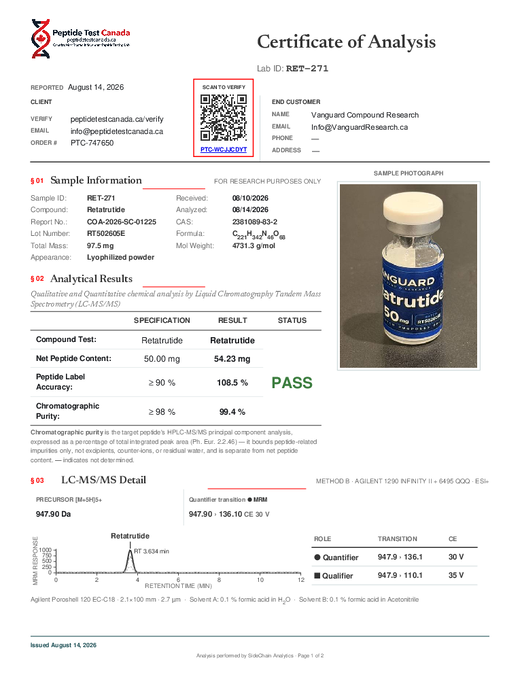
HPLC purity alone also does not establish total peptide quantity, identity, sterility, endotoxin status or suitability for biological use. Each analytical measurement addresses a different characteristic of the sample.
Long-term safety, broader population effects and several clinical outcomes remain subjects of ongoing investigation.
Research Status
Retatrutide remains an investigational metabolic research compound.
Phase 3 research programs are evaluating its effects across several obesity- and metabolic-related study populations. Canadian clinical-trial records continue to list Retatrutide in ongoing investigational studies.
Retatrutide is not authorized by Health Canada as an injectable research product for consumer therapeutic use. Health Canada has specifically identified unauthorized Retatrutide products among peptide products marketed online and has stated that “research use only” labelling does not itself exempt a product from applicable regulatory requirements.
For laboratory research only. Not for human or veterinary use.