


GHK-Cu is a blue copper-binding tripeptide complex made from glycine, histidine and lysine. Researchers study it in laboratory and preclinical models for its possible roles in copper transport, cell signalling, extracellular-matrix activity and tissue-remodelling processes.
Research is based mainly on cell, animal and limited formulation-specific human studies. Human benefits, safety, dosage and long-term effects have not been established for this research material. GHK-Cu is not authorized by Health Canada for therapeutic or injectable use.
This material is intended for laboratory research only, is not authorized by Health Canada for human therapeutic use, and is not intended for human or veterinary administration.
Choose a kit option to save more, or skip this and buy individually above.

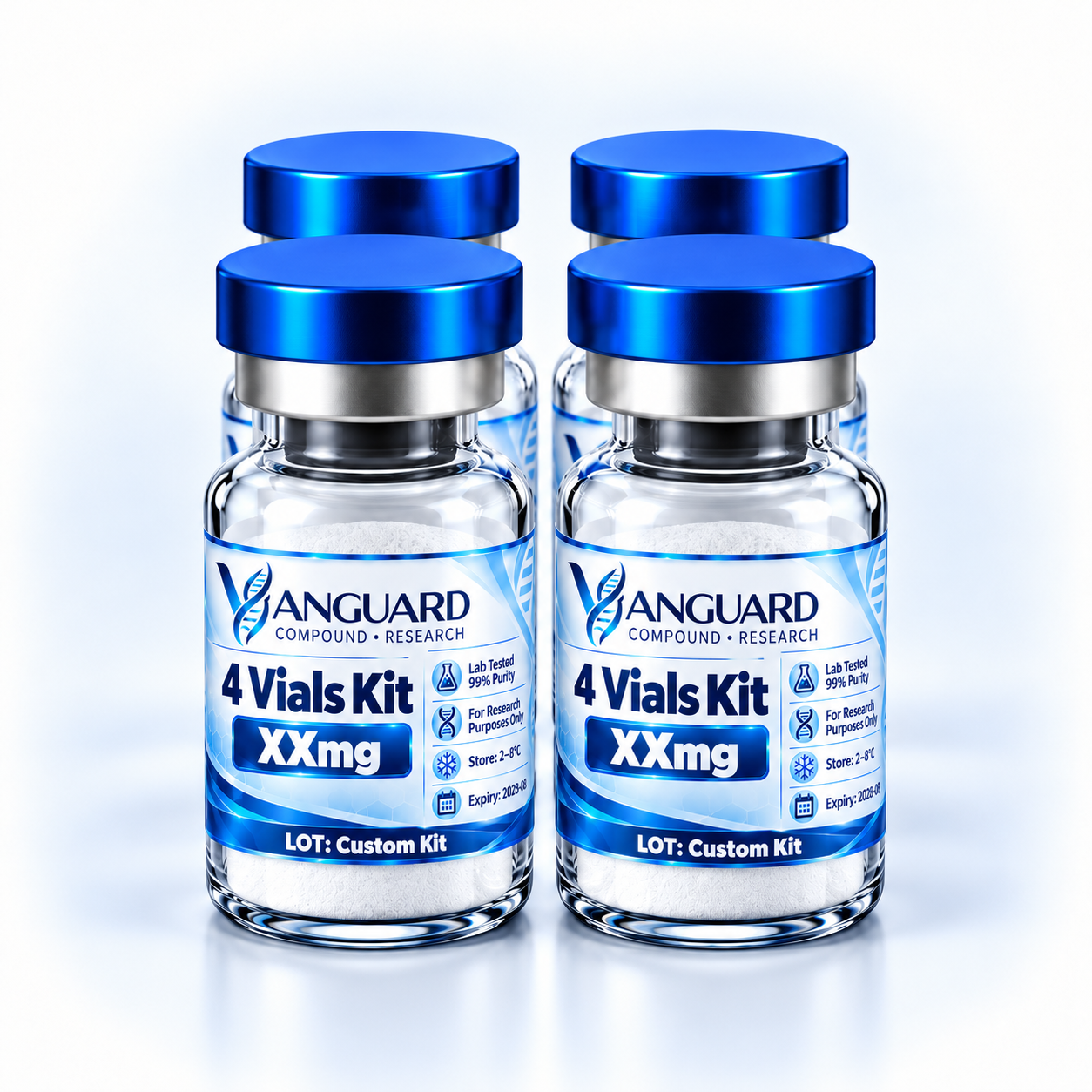


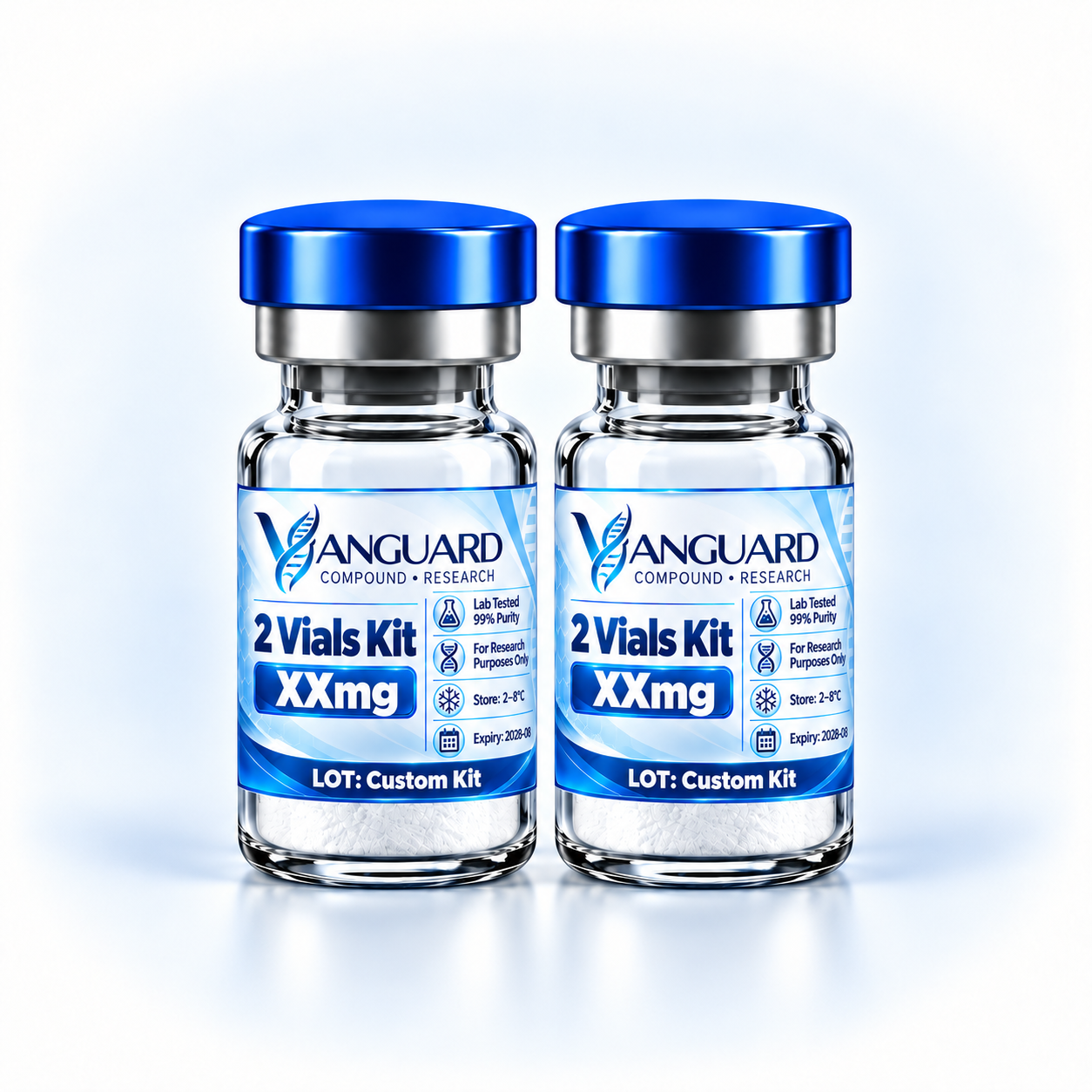
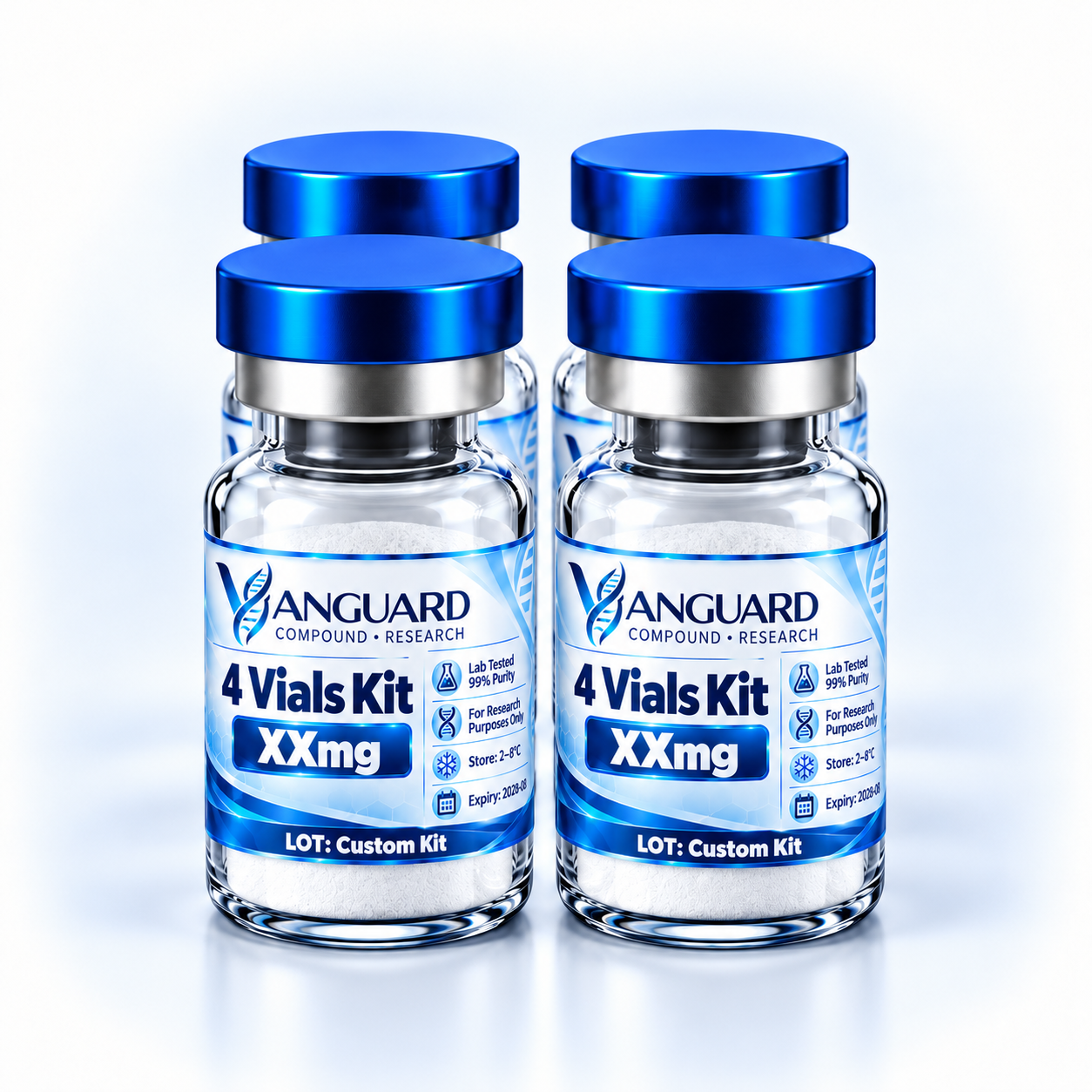


*LC-MS identity confirmation may be performed when analytical review indicates conflicting, atypical, or inconclusive results.
GHK-Cu is the copper(II) complex of glycyl-L-histidyl-L-lysine, a small peptide commonly shortened to GHK. The peptide contains three naturally occurring amino acids—glycine, histidine and lysine—joined in that order. GHK was first identified as a copper-binding component of human plasma, and researchers later examined related material in other biological fluids and experimental systems. When GHK coordinates copper, it forms the blue complex generally called GHK-Cu, Copper Tripeptide-1 or prezatide copper.
The complex is small, but its chemistry is more nuanced than the phrase “a peptide with copper added” suggests. The amino terminus, peptide nitrogens and histidine imidazole group can participate in copper coordination. A mononuclear 1:1 complex has been characterized under commonly studied near-neutral conditions, while the exact species present can vary with pH, concentration, counterions and surrounding ligands. A single formula or structural drawing therefore may not describe every solid or solution sold under the broad name GHK-Cu.
This distinction matters in research. Copper-free GHK, a defined copper complex, an acetate-associated form and a hydrated preparation are not automatically interchangeable. They may differ in molecular weight, percentage of peptide, copper content, charge and analytical response. Product identity should be tied to the stated chemical form and the documentation for the applicable batch, rather than inferred from the product name or blue colour alone.
Copper is a trace element used by many proteins and enzymes. It can support normal biochemical reactions when it is held in the right molecular environment, but unbound copper can also participate in unwanted reactions. Copper-binding molecules help control where copper is located, how strongly it is held and whether it can be exchanged with other molecules.
GHK acts as a small copper-binding ligand. Its atoms form several contact points around a copper ion, creating a coordination complex. That interaction changes the chemical behaviour of both the peptide and the metal. Researchers study the complex to understand copper-peptide coordination, metal exchange and possible effects on cell signalling and extracellular-matrix activity.
The extracellular matrix is the organized network around cells. It includes collagen, glycosaminoglycans and other structural components that help give tissues their mechanical and biochemical environment. Cells continually build, modify and break down this network. Because some laboratory studies have reported changes in matrix-related markers after exposure to GHK-Cu, the complex is often used as an experimental probe in repair and remodelling research.
These observations do not mean that GHK-Cu automatically repairs tissue or produces a cosmetic result. A molecular response in a cultured cell is an early research signal, not a demonstrated benefit in a person. Concentration, formulation, pH, copper availability, exposure time and the biological model can all change the outcome.
GHK-Cu has been examined through several kinds of experiments. Each model answers a different question and has different limits:
Results must be interpreted within the exact method used. A study involving a formulated cream is evidence about that preparation, concentration and application method. A cell experiment is evidence about the cells and conditions tested. Neither establishes the safety or effectiveness of a vial sold for laboratory research.
Fibroblasts are cells that help produce and organize extracellular-matrix components. In laboratory systems, investigators have reported changes in collagen production and other matrix-related measurements after exposure to copper-peptide material. One early fibroblast study examined stimulation of collagen synthesis by a tripeptide-copper complex. Other work has evaluated glycosaminoglycans, which are water-binding molecules that contribute to the physical properties of the matrix.
These experiments are useful for exploring mechanisms, but they do not establish a universal response. Fibroblasts from different tissues or donors may behave differently, and results can change with culture conditions, passage number, copper availability and exposure duration. A measured increase in one matrix component also does not by itself show that the resulting tissue would be stronger, healthier or clinically improved.
Researchers may also examine enzymes involved in matrix remodelling. Building and breaking down matrix are linked processes, so a change in an enzyme or signalling marker can have different meanings depending on timing and biological context. Mechanistic findings should therefore be reported as specific laboratory observations rather than converted into broad claims such as “rebuilds collagen” or “reverses ageing.”
Preclinical studies have examined GHK-Cu in wound chambers, open-wound systems and models involving impaired or irradiated tissue. A rat wound-chamber study, for example, assessed accumulation of collagen and other matrix components. Other animal work has evaluated wound closure, tissue organization or mechanical measurements under controlled experimental conditions.
Animal models can help researchers test biological hypotheses in living systems, but they do not reproduce every feature of human skin or clinical care. Species differences, wound type, dose, delivery vehicle and study design can materially affect the result. An improvement in a laboratory animal endpoint is not proof that a research vial heals human wounds or treats a skin condition.
Small human studies involving finished topical formulations have also been discussed in the literature, including research after dermatologic procedures. Such studies may provide preliminary information about the tested formulation, but they do not validate an injectable route, systemic use or every commercial material labelled GHK-Cu. The vehicle, preservatives, concentration, manufacturing controls and study population are part of the evidence and cannot be separated from the product that was actually tested.
GHK-Cu is frequently marketed online in connection with hair growth. The supporting discussion often combines cell findings, animal work, related copper peptides and studies of finished cosmetic formulations. Those categories are not equivalent. Changes in follicle-associated cells or hair-cycle markers in an experimental model do not establish that unformulated GHK-Cu reverses hair loss in humans.
Reliable conclusions would require well-controlled human trials using a clearly characterized formulation, appropriate comparison groups, predefined endpoints and sufficient follow-up. Current evidence does not establish an approved indication, validated dose, administration route or predictable hair-growth effect for this research material. Claims such as “regrows hair,” “stops hair loss” or “clinically proven” would exceed the evidence available for the product described on this page.
GHK-Cu research identifies biological questions that may be worth studying further. Its copper-binding chemistry and reported effects in selected experimental models make it a useful tool for investigating matrix biology, metal-peptide interactions and repair-related signalling. That scientific interest is not the same as a confirmed medical or cosmetic benefit.
Human relevance depends on more than whether a response can be measured in a dish or an animal. Researchers must determine whether a well-characterized formulation reaches the intended site, remains stable, produces a meaningful effect and does so without unacceptable risk. Route of exposure is especially important: evidence concerning a topical formulation cannot be used to infer the safety of injection, ingestion or systemic administration.
Published evidence does not establish a human dosage, injectable protocol, long-term safety profile or therapeutic indication for GHK-Cu research powder. People considering a health or cosmetic treatment should rely on an authorized product and qualified health professional rather than extrapolating from preclinical studies or online protocols.
Several limitations should be kept in view when interpreting GHK-Cu research:
Analytical questions should also remain separate. Chromatography can estimate peptide-related purity under a defined method; mass spectrometry can support identity; a validated quantitative assay can assess vial content; and ICP-MS or ICP-OES can measure copper. One result should not be presented as though it establishes all of those attributes.
GHK-Cu remains an experimental research compound. It is used to investigate copper-peptide chemistry, extracellular-matrix biology, analytical characterization and related preclinical questions. Its research value depends on careful characterization of the exact material and on conclusions that remain proportionate to the model and methods used.
Health Canada has identified GHK-Cu among unauthorized injectable peptide drugs. GHK-Cu is not authorized by Health Canada for therapeutic or injectable use, and a “research use only” label does not make a product suitable or authorized for human administration. No human dosage, administration route or treatment protocol is provided here.
This material is supplied exclusively for controlled laboratory research. It is not a sterile drug, injectable preparation, food, dietary supplement, natural health product, veterinary product or finished cosmetic. It is not intended for human or veterinary use.
GHK-Cu is a copper–tripeptide coordination complex formed from glycyl-L-histidyl-L-lysine and copper(II). It is commonly described as Copper Tripeptide-1 or prezatide copper. The supplied material should be identified by its exact chemical form because copper-free GHK, the copper complex, acetate-associated material and hydrated forms do not have the same formula or molecular weight.
The representative formula and molecular weight describe a commonly referenced prezatide-copper ion. Counterions, protonation, hydration and acetate association can change the composition of a commercial solid. Quantitative calculations should use the chemical form confirmed in the applicable batch documentation.
The parent GHK peptide contains three naturally occurring amino acids—glycine, L-histidine and L-lysine—joined by two peptide bonds. Its amino terminus, peptide nitrogens and histidine imidazole group can participate in coordinating copper. Under commonly studied near-neutral conditions, GHK and copper can form a mononuclear 1:1 complex.
Copper coordination is affected by pH, concentration, counterions and competing ligands. The complex present in a solution may therefore differ from the form present in the original dried solid. A product name, formula or blue colour should not be used alone to establish copper stoichiometry or the exact species present.
These molecular values are reference information rather than confirmation of the exact solid form in a particular vial. Copper content, peptide content and complex ratio require appropriate batch-specific analysis.
The term “lyophilized” should be used only when freeze-drying is confirmed by the manufacturer or batch documentation. Blue colour may be consistent with a copper-containing complex, but appearance cannot establish identity, purity, quantity, sterility, endotoxin level or copper stoichiometry.
Chromatographic purity: High-performance liquid chromatography or LC-MS/MS chromatography may be used to separate the principal peptide-related component from detectable impurities under a defined method. The reported percentage is normally a relative peak-area result. It is not the same as total material purity by weight and does not independently establish copper content, vial quantity, counterion content, water, residual solvents, sterility or endotoxin status.
Appropriate chromatographic documentation should identify the product, batch number, sample-preparation procedure, reference standard, column, mobile-phase conditions, detection method, retention time, principal peak area, calculated purity, system-suitability criteria, analysis date and laboratory authorization.
Identity assessment: Mass spectrometry can support identification of the GHK peptide component. The ions observed depend on sample preparation, ionization, protonation, adduct formation and whether the copper complex remains intact during analysis. Detection near the mass of copper-free GHK may show the peptide component but does not, by itself, prove that the original sample contained an intact 1:1 GHK-Cu complex.
Copper and complex characterization: Total copper may be assessed using ICP-MS, ICP-OES or another validated elemental method. When a defined peptide-to-copper ratio is important, copper measurement should be evaluated together with a quantitative peptide assay and identification of the supplied chemical form.
Depending on the research application, a broader analytical package may include:
Only analyses completed for the applicable batch should be presented as verified product attributes.
The current product page includes 50 mg and 100 mg batches analyzed through Peptide Test Canada, with analysis performed by SideChain Analytics:
Chromatographic purity, net peptide content, total vial mass, copper content and complex stoichiometry are separate measurements. A purity percentage should not be multiplied by total vial mass and presented as confirmed GHK-Cu quantity unless the assay, chemical form and calculation support that conclusion.
Keep the unopened material in its original sealed container, protected from direct light and moisture. Use the storage temperature supported by supplier documentation or stability information for the applicable batch. The current Certificates of Analysis do not state a validated storage temperature.
If cold storage is specified elsewhere in the qualified product documentation, allow the sealed container to approach the intended laboratory handling temperature before opening when condensation is a concern. Any expiry or retest date should be supported by the manufacturer, supplier or appropriate stability data.
This product is supplied exclusively as a laboratory research material. It is not manufactured or released as a sterile drug product, injectable preparation, food, dietary supplement, natural health product, veterinary product or finished cosmetic.
It is not intended for:
No human dosage, administration route, application schedule or treatment protocol is provided. GHK-Cu is not authorized by Health Canada for therapeutic or injectable use. Published laboratory and animal findings do not establish the safety or effectiveness of this material in humans.
These specifications describe the general identity, physical characteristics, analytical boundaries and intended research classification of GHK-Cu. Final release information must be based on the Certificate of Analysis and manufacturing documentation for the specific batch.
Where general product information and batch-specific documentation differ, the discrepancy should be resolved before publication or use. Customers should review the applicable analytical records before beginning laboratory work. A Certificate of Analysis reports only the sample and tests described; it is not evidence of regulatory authorization, clinical safety or therapeutic effectiveness.
Additional documentation available upon request.
Each batch undergoes analytical review using validated laboratory procedures. HPLC testing is utilized to assess purity and compare the sample profile against established reference standards. Where additional verification is warranted, LC-MS analysis may be performed to support compound identity confirmation.
*See LC-MS Confirmation Information for full details.
Every batch supplied by Vanguard Compound Research is assigned a unique batch number and maintained under documented quality-control procedures with supporting analytical documentation available upon request.
All Vanguard Compound Research orders are shipped directly from within Canada, ensuring efficient delivery, reliable service, and consistent quality-control from fulfillment to arrival.
Products are maintained under documented quality-control procedures to help ensure quality, consistency, and transparency.
Each product is assigned a unique lot number, allowing researchers to match their item directly to its corresponding Certificate of Analysis (COA).
Supporting analytical documentation may be available for qualifying products, including batch-specific quality records and testing information.
Documentation may include:


