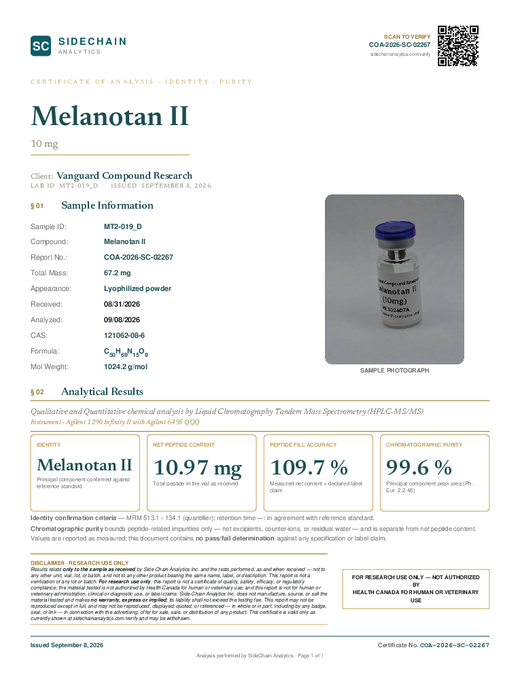
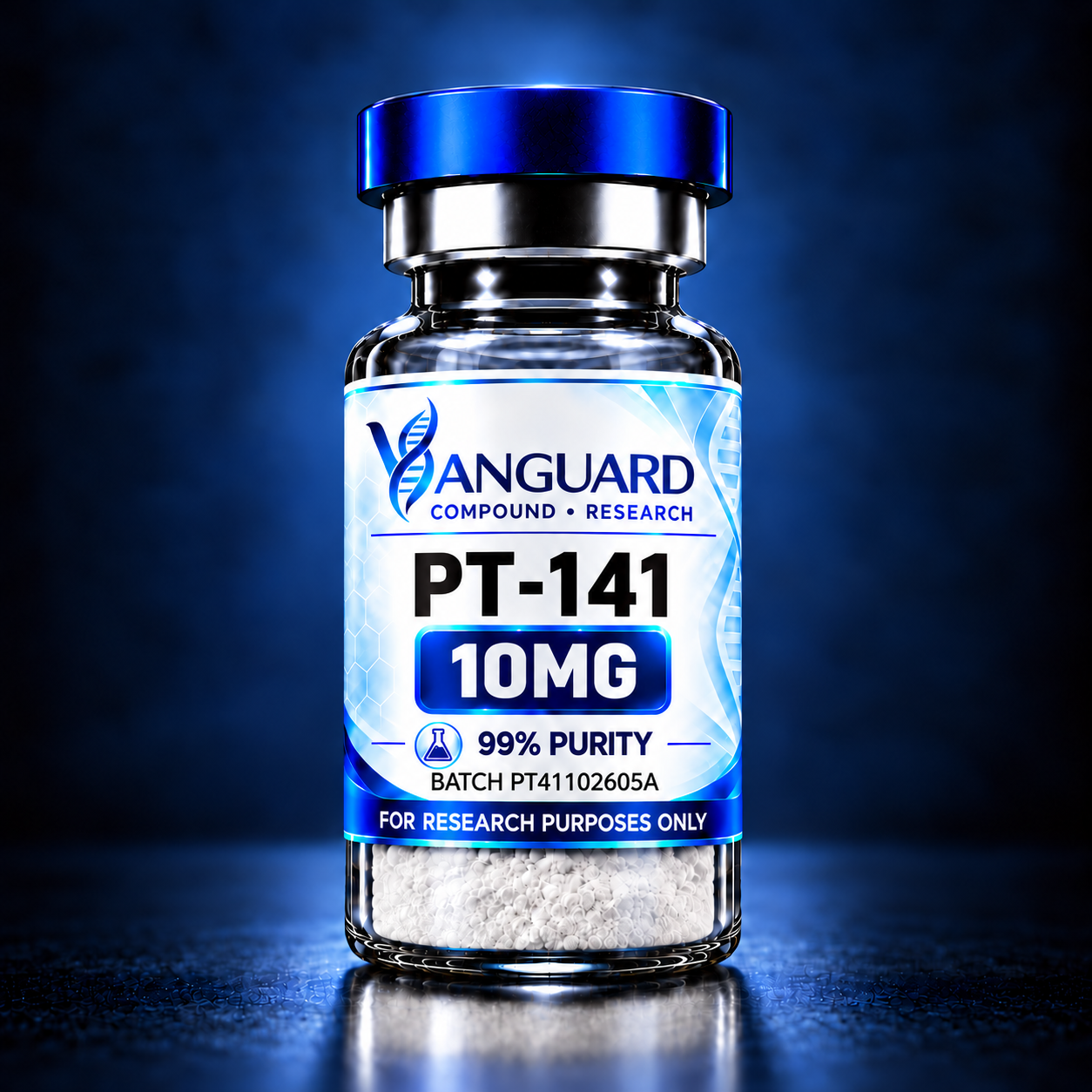
Melanotan II is a synthetic cyclic melanocortin peptide analogue developed from research into alpha-melanocyte-stimulating hormone (α-MSH). It is primarily investigated for its activity at melanocortin receptors involved in pigmentation, appetite regulation, energy balance, and neuroendocrine signaling. One of its best-known research effects is stimulation of melanogenesis through activation of the melanocortin-1 receptor, which can increase melanin production in experimental models. Melanotan II also interacts with central melanocortin receptors, particularly MC3R and MC4R, making it relevant to studies involving appetite, metabolism, and sexual-response pathways. Early human research explored its effects on skin pigmentation and erectile responses, but these findings do not establish it as an approved therapeutic product. Because Melanotan II is a non-selective melanocortin agonist, researchers use it to study how different melanocortin receptor subtypes contribute to diverse physiological processes. Its cyclic structure provides greater resistance to enzymatic breakdown than native α-MSH. This material is intended for laboratory research only, is not authorized by Health Canada for human therapeutic use, and is not intended for human or veterinary administration.
Choose a kit option to save more, or skip this and buy individually above.
*LC-MS identity confirmation may be performed when analytical review indicates conflicting, atypical, or inconclusive results.
Melanotan II, commonly abbreviated MT-II or MT2, is a synthetic cyclic peptide analogue of alpha-melanocyte-stimulating hormone (α-MSH).
α-MSH is an endogenous peptide derived from the larger precursor protein proopiomelanocortin (POMC) and is involved in melanocortin receptor signaling throughout the body.
Melanotan II was designed to retain melanocortin receptor activity while improving resistance to enzymatic degradation compared with native α-MSH.
Its research applications extend beyond pigmentation because melanocortin receptors participate in a wide range of biological functions, including:
Melanotan II is therefore best understood as a broad melanocortin receptor agonist rather than solely as a pigmentation compound.
Alpha-MSH is a naturally occurring melanocortin peptide that binds to several members of the melanocortin receptor family.
Native α-MSH contains a central amino-acid sequence responsible for much of its receptor-binding activity.
Melanotan II was developed by modifying this pharmacophore and creating a cyclic peptide structure.
Cyclization can:
This makes Melanotan II substantially more stable than native α-MSH in many laboratory environments.
Melanotan II is a cyclic heptapeptide.
Its commonly represented structure is:
Ac-Nle-cyclo[Asp-His-D-Phe-Arg-Trp-Lys]-NH₂
Several structural features are important.
Norleucine is a non-standard amino-acid analogue used in peptide design.
Its inclusion improves stability compared with methionine-containing sequences that may be more susceptible to oxidation.
Melanotan II includes D-phenylalanine, rather than the naturally occurring L-form.
D-amino-acid substitution can increase resistance to enzymatic degradation and alter receptor-binding properties.
This modification is one reason Melanotan II is more persistent in experimental systems than native α-MSH.
The cyclic portion of Melanotan II is produced by linking residues within the peptide.
This conformational constraint helps stabilize the biologically active shape of the molecule.
Cyclic peptides are often studied because they can exhibit:
Melanotan II interacts with several members of the melanocortin receptor family.
These receptors are G-protein-coupled receptors and include:
Melanotan II is most relevant to research involving MC1R, MC3R, MC4R, and MC5R.
Because the compound is not highly selective for a single receptor subtype, different biological effects can occur depending on the tissue being studied.
The melanocortin-1 receptor (MC1R) is strongly associated with melanocyte biology.
Melanocytes are specialized cells responsible for producing the pigment melanin.
When MC1R is activated, intracellular signaling can increase activity of enzymes involved in melanogenesis.
This makes Melanotan II a widely studied research compound in:
Melanogenesis is the biological process through which melanin is synthesized.
Melanin contributes to pigmentation of:
Melanotan II research commonly examines increases in melanogenic signaling through MC1R.
Important research pathways include:
MC1R activation
↓
cAMP signaling
↓
melanogenic gene expression
↓
increased melanin synthesis
This pathway makes Melanotan II useful for studying the molecular regulation of pigmentation.
Melanin plays a role in the skin's response to ultraviolet exposure.
Because Melanotan II can stimulate melanogenesis, researchers have investigated melanocortin signaling in the context of:
Increased pigmentation should not automatically be interpreted as complete protection against ultraviolet injury.
Melanotan II is not a replacement for conventional UV-protection strategies.
The melanocortin-3 receptor (MC3R) is expressed in parts of the central nervous system and is involved in energy-balance regulation.
Research involving MC3R examines:
Because Melanotan II can activate MC3R, it is used experimentally to study how melanocortin signaling influences metabolic regulation.
The melanocortin-4 receptor (MC4R) is one of the most extensively studied receptors in appetite and body-weight biology.
MC4R signaling contributes to regulation of:
Melanotan II has therefore been used in experimental models investigating how melanocortin activation influences feeding behavior and metabolism.
These findings are mechanistic and do not establish Melanotan II as an approved weight-management therapy.
Experimental studies involving Melanotan II have investigated reductions in food intake associated with central melanocortin signaling.
This area of research helped establish the importance of MC4R in appetite regulation.
Researchers may evaluate:
Melanotan II is useful in this context because it activates multiple melanocortin pathways simultaneously.
One of the more unusual research observations involving Melanotan II is its effect on sexual-response pathways.
Early clinical investigation reported erectile responses in some human subjects.
This effect appears to be associated primarily with central nervous-system melanocortin signaling rather than direct vascular stimulation.
Research interest includes:
This research contributed to development of more selective melanocortin compounds for sexual-function investigation.
Melanocortin receptors are widely distributed in several brain regions.
Melanotan II is therefore used experimentally to study central melanocortin pathways involved in:
The compound's ability to activate multiple melanocortin receptor subtypes makes it useful in mechanistic neuroscience models.
Melanocortin signaling connects nervous-system activity with endocrine responses.
Melanotan II research can therefore involve:
These interconnected pathways explain why a melanocortin agonist can influence seemingly unrelated biological systems.
The melanocortin-5 receptor (MC5R) is expressed in several peripheral tissues.
Research involving MC5R includes:
Melanotan II can interact with MC5R and may therefore be useful in studies examining these less-characterized melanocortin pathways.
Melanocortin peptides are also associated with immunomodulatory signaling.
Although Melanotan II is primarily studied for pigmentation and central melanocortin effects, researchers also investigate melanocortin pathways in relation to:
These effects remain highly dependent on receptor subtype and experimental model.
Melanocortin receptors generally signal through G-protein-coupled pathways.
A simplified pathway can be represented as:
Melanotan II
↓
Melanocortin receptor activation
↓
Adenylyl cyclase activation
↓
Increased cyclic AMP (cAMP)
↓
Protein kinase A signaling
↓
Changes in gene expression and cellular activity
The exact response depends on receptor subtype and tissue.
Melanotan II became an important research molecule because it demonstrated that melanocortin signaling controls considerably more than pigmentation.
Its experimental effects helped researchers study relationships between:
pigmentation → metabolism → appetite → neuroendocrine signaling → sexual response
This broad biological activity has also encouraged development of newer melanocortin compounds with greater receptor selectivity.
The commonly reported Melanotan II structure is:
Ac-Nle-cyclo[Asp-His-D-Phe-Arg-Trp-Lys]-NH₂
The peptide contains seven principal amino-acid residues and is structurally constrained through cyclization.
Melanotan II is a synthetic cyclic melanocortin peptide analogue.
Its cyclic structure differentiates it from linear melanocortin peptides and contributes to increased stability and receptor activity in experimental systems.
Research association:
Research association:
Research association:
Research association:
Melanotan II is commonly investigated in:
Melanotan II functions primarily as a melanocortin receptor agonist.
A simplified mechanism can be represented as:
Melanotan II
↓
MC1R / MC3R / MC4R / MC5R activation
↓
cAMP-dependent intracellular signaling
↓
Tissue-specific biological response
Possible research outcomes vary substantially depending on which receptor subtype is expressed in the tissue being studied.
Peptide type: Cyclic heptapeptide
Molecular formula: C₅₀H₆₉N₁₅O₉
Molecular weight: Approximately 1024.2 g/mol
CAS number: 121062-08-6
Nominal vial strength: 10 mg
Chemical class: Melanocortin peptide analogue
Form: Lyophilized powder
Nominal content: 10 mg per vial
Compound type: Synthetic cyclic peptide
Primary research category: Melanocortin receptor research
Presentation: Research vial
Lyophilization is commonly used with research peptides to remove water and improve stability during appropriate storage.
Melanotan II is typically handled in aqueous laboratory systems.
Specific solvent selection, concentration, pH, and experimental preparation should be determined by the individual research protocol.
Relevant experimental variables include:
These parameters should remain standardized across experimental groups.
General laboratory considerations include:
Storage conditions should be selected according to the requirements of the individual experimental protocol.
Melanotan II may be relevant to controlled laboratory investigations involving:
Researchers may examine endpoints such as:
Melanotan II 10 mg is intended for controlled laboratory research involving:
Available evidence includes animal research and limited early human investigation. These findings should not automatically be interpreted as establishing therapeutic efficacy or safety.
Melanotan II remains an investigational research compound.
It is not authorized by Health Canada for human or veterinary use.
The product is intended strictly for laboratory and research purposes and is not intended for clinical, diagnostic, therapeutic, cosmetic, or veterinary administration.
No documents available for this product yet.
Additional documentation available upon request.
Each batch undergoes analytical review using validated laboratory procedures. HPLC testing is utilized to assess purity and compare the sample profile against established reference standards. Where additional verification is warranted, LC-MS analysis may be performed to support compound identity confirmation.
*See LC-MS Confirmation Information for full details.
Every batch supplied by Vanguard Compound Research is assigned a unique batch number and maintained under documented quality-control procedures with supporting analytical documentation available upon request.
All Vanguard Compound Research orders are shipped directly from within Canada, ensuring efficient delivery, reliable service, and consistent quality-control from fulfillment to arrival.
Products are maintained under documented quality-control procedures to help ensure quality, consistency, and transparency.
Each product is assigned a unique lot number, allowing researchers to match their item directly to its corresponding Certificate of Analysis (COA).
Supporting analytical documentation may be available for qualifying products, including batch-specific quality records and testing information.
Documentation may include: