Free shipping on all orders $250CAD or more within Canada.

Tesamorelin

  • HOME
  • |
  • Tesamorelin

Tesamorelin

SKU TSM102605B

Tesamorelin is a synthetic peptide analogue of growth hormone-releasing hormone (GHRH), a naturally occurring signalling hormone involved in regulating the release of growth hormone from the pituitary gland. Researchers study tesamorelin for its effects on the GHRH receptor, growth hormone signalling, IGF-1 production, body-composition pathways and metabolic activity.

Unlike many experimental research peptides, tesamorelin has also been studied extensively in humans, particularly in research involving excess visceral abdominal fat associated with HIV-related lipodystrophy. These clinical findings provide useful information about its biological activity, but they do not establish the safety, effectiveness or appropriate use of independently manufactured research material. The research material offered here is not an authorized Health Canada prescription drug product and should not be considered equivalent to an approved pharmaceutical preparation.

This material is intended for laboratory research only, is not authorized by Health Canada for human therapeutic use, and is not intended for human or veterinary administration.


CA$89.99

In Stock

Choose a kit option to save more, or skip this and buy individually above.

Save 8%
2 Vials x 10mg
CA$165.00 CA$180.00
Save 13%
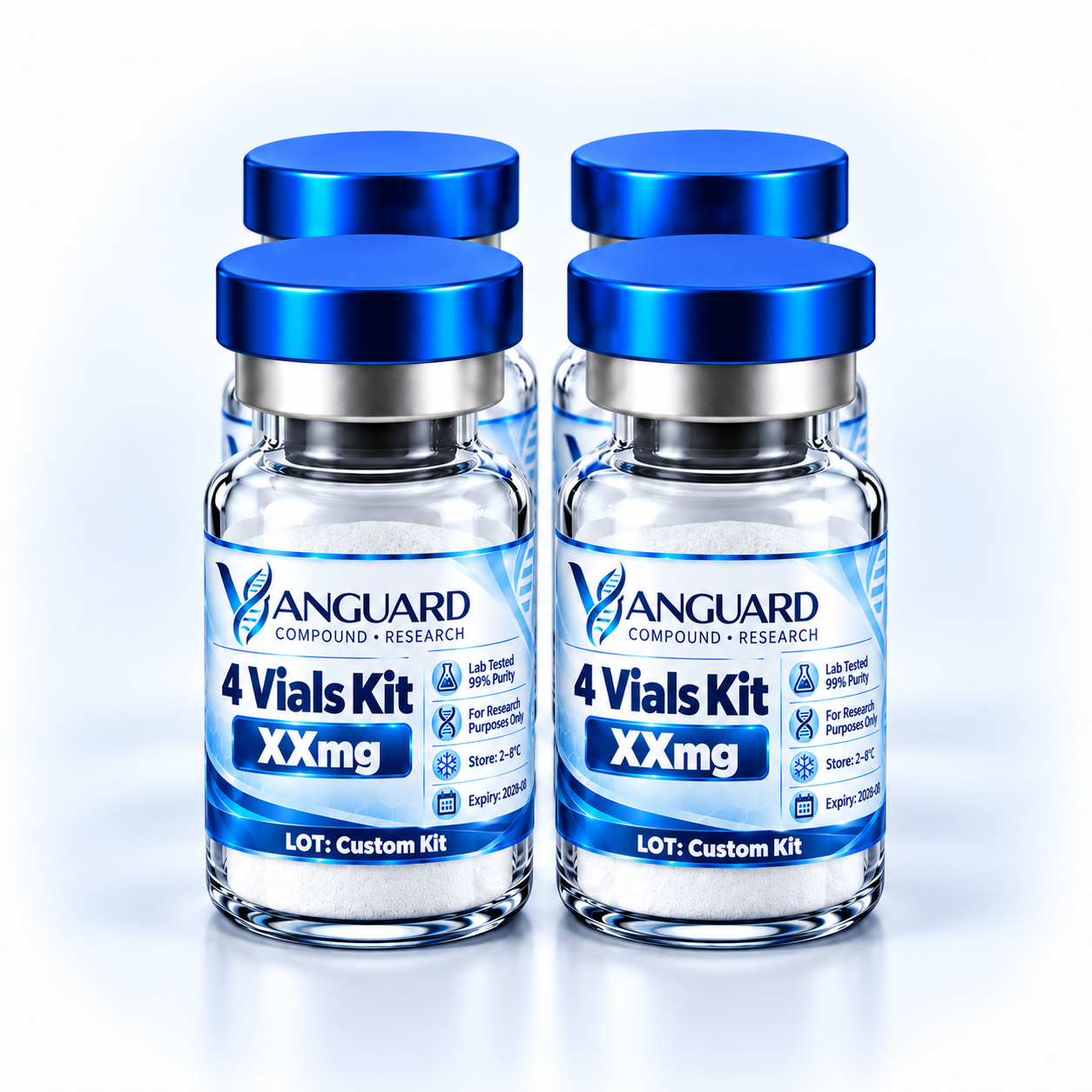
4 vials x 10mg
CA$315.00 CA$360.00
Save 20%
6 Vials x 10mg
CA$430.00 CA$540.00
Save 25%
10 Vials x 10mg
CA$675.00 CA$900.00
HPLC Purity Verified
Batch Documented
LC-MS Confirmation Available
2°C Storage

*LC-MS identity confirmation may be performed when analytical review indicates conflicting, atypical, or inconclusive results.

Tesamorelin Research Overview

What is Tesamorelin?

Tesamorelin is a synthetic analogue of growth hormone-releasing hormone, commonly abbreviated GHRH. GHRH is normally produced by the hypothalamus and acts as a signalling molecule between the brain and the pituitary gland. One of its primary biological functions is to stimulate specialized pituitary cells to produce and release growth hormone.

Tesamorelin was designed to interact with this same biological pathway. Structurally, it is based on the 44-amino-acid sequence of human GHRH but contains an N-terminal modification that improves its stability compared with naturally occurring GHRH.

This increased stability allows researchers to investigate GHRH-receptor signalling over a more practical experimental period while still maintaining a mechanism that closely resembles the activity of endogenous GHRH.

Understanding the GHRH Pathway in Simple Terms

The growth hormone system can be thought of as a biological signalling chain.

The hypothalamus releases GHRH, which communicates with the pituitary gland. The pituitary then releases growth hormone, commonly shortened to GH. Growth hormone circulates through the body and influences numerous tissues while also stimulating production of insulin-like growth factor 1, or IGF-1.

Tesamorelin acts near the beginning of this pathway by binding to and activating GHRH receptors on pituitary cells.

This is an important distinction from administering growth hormone itself. Tesamorelin does not chemically replace growth hormone. Instead, researchers use it to study stimulation of the body's existing GH-secretory pathway and the downstream biological changes associated with that signalling.

Growth Hormone and IGF-1 Research

Activation of the GHRH receptor can increase the synthesis and pulsatile release of endogenous growth hormone. Growth hormone subsequently contributes to the regulation of protein metabolism, lipid metabolism, glucose metabolism and IGF-1 production.

IGF-1 is produced primarily by the liver in response to growth-hormone signalling, although it is also produced locally in other tissues. Researchers frequently measure IGF-1 as one indicator of downstream GH-axis activity.

Tesamorelin research therefore provides a way to examine several connected biological systems rather than studying a single isolated pathway.

These include pituitary signalling, growth-hormone secretion, IGF-1 regulation, lipid metabolism and changes in adipose-tissue distribution.

Visceral Fat and Body-Composition Research

One of the most extensively investigated areas of tesamorelin research involves visceral adipose tissue.

Visceral fat is the adipose tissue located deeper within the abdominal cavity around internal organs. It is biologically different from the subcutaneous fat located directly underneath the skin and is associated with distinct metabolic signalling pathways.

Human clinical studies involving individuals with HIV-associated lipodystrophy demonstrated that pharmacological tesamorelin can reduce excess visceral abdominal fat. This research ultimately led to the development of prescription tesamorelin products for this specific medical condition in certain jurisdictions.

The significance of these studies extends beyond simple changes in body weight. Researchers have been particularly interested in how activation of the GHRH/GH axis can influence where fat is stored, how lipid metabolism is regulated and how visceral adipose tissue responds to changes in growth-hormone signalling.

Tesamorelin should therefore not simply be described as a conventional weight-loss compound. Its established research history is more specifically connected with growth-hormone signalling and changes in visceral adipose tissue.

Metabolic Research

Growth hormone affects several metabolic systems, which has led researchers to examine tesamorelin in areas extending beyond body composition.

Research has evaluated changes in lipid metabolism, triglycerides, glucose regulation, insulin sensitivity and liver-associated metabolic markers.

These systems are interconnected. Growth hormone can promote the mobilization of stored fatty acids while simultaneously influencing glucose metabolism and insulin signalling. As a result, increasing activity within the GH/IGF-1 pathway can produce a mixture of biological effects rather than one isolated response.

This is one reason laboratory and clinical interpretation of tesamorelin requires consideration of multiple biomarkers instead of relying on body composition alone.

Liver and Ectopic-Fat Research

Tesamorelin has also attracted research interest involving fat accumulation outside normal adipose tissue, particularly within the liver.

Clinical investigators have explored whether modification of the GH axis and reductions in visceral adiposity may influence hepatic lipid accumulation and other metabolic characteristics associated with excess liver fat.

These studies are scientifically important because visceral adipose tissue, liver fat, circulating lipids and insulin signalling are closely related metabolic systems.

However, research into these additional applications should not be interpreted as establishing tesamorelin as a general treatment for liver disease or metabolic disorders.

Why Researchers Study Tesamorelin

Tesamorelin occupies an unusual position among research peptides because its biological pathway is relatively well characterized and significant human clinical data exist.

Researchers may use tesamorelin-related models when examining:

  • GHRH-receptor activation and pituitary signalling
  • Pulsatile endogenous growth-hormone release
  • IGF-1 regulation
  • Visceral adipose-tissue biology
  • Lipid mobilization and lipid metabolism
  • Body-composition changes
  • Glucose and insulin-related metabolic signalling
  • Hepatic and ectopic-fat research
  • Relationships between the hypothalamus, pituitary gland, liver and peripheral tissues

The existence of human clinical research provides more translational information than is available for many experimental peptides. It does not, however, mean that independently manufactured research material has the same manufacturing controls, purity, sterility, pharmacokinetics or safety profile as a regulated pharmaceutical product.

Human Research Context

Tesamorelin is not simply a compound with theoretical or animal-only evidence.

Pharmaceutical tesamorelin has undergone controlled human clinical investigation and has been used as the active ingredient in prescription products developed for reducing excess abdominal fat in adults with HIV-associated lipodystrophy.

This provides direct evidence that the tesamorelin molecule can activate the human GHRH/GH/IGF-1 pathway.

It remains important to separate evidence about a regulated pharmaceutical preparation from claims about independent laboratory material. Clinical results obtained using an authorized drug formulation cannot automatically be transferred to another product solely because it carries the same compound name.

Manufacturing quality, chemical identity, peptide content, degradation, impurities, sterility, endotoxin status and formulation can all affect the characteristics of a research preparation.

Current Evidence Limitations

Tesamorelin has considerably more human evidence than many compounds commonly classified as research peptides, but its evidence should still be interpreted within the conditions in which that research was performed.

Established clinical research has primarily involved specific patient populations, defined pharmaceutical formulations and controlled medical protocols. Those findings should not automatically be generalized to healthy individuals, athletic performance, general anti-aging applications or unrelated medical conditions.

Individual analytical purity results also do not demonstrate clinical safety. A high HPLC purity percentage describes the chromatographic composition measured under a particular analytical method; it does not independently establish sterility, endotoxin levels, accurate peptide quantity, biological activity or suitability for administration.

Regulatory and Research-Use Context

Tesamorelin previously received Health Canada authorization as the prescription product EGRIFTA. Health Canada's current Drug Product Database lists the former Canadian EGRIFTA DINs as cancelled.

The tesamorelin material supplied by Vanguard Compound Research is laboratory research material and is not an authorized prescription drug product. It should not be represented as pharmaceutical EGRIFTA or as equivalent to an approved medicinal product.

No human dosage, administration schedule, reconstitution procedure or treatment protocol is provided with this research material.

For laboratory research only. Not for human or veterinary use.

Tesamorelin Product Specifications

Product Identification

Tesamorelin is a synthetic 44-amino-acid analogue of human growth hormone-releasing hormone. It contains a stabilizing modification at the N-terminus and is designed to retain biological activity at the growth hormone-releasing hormone receptor.

  • Product name: Tesamorelin
  • Research designation: TH9507
  • Compound type: Synthetic peptide
  • Chemical class: Growth hormone-releasing hormone analogue
  • Biological target: Growth hormone-releasing hormone receptor / GHRH receptor
  • Peptide length: 44 amino acids
  • Sequence: YADAIFTNSYRKVLGQLSARKLLQDIMSRQQGESNQERGARARL
  • Tesamorelin CAS number: 218949-48-5
  • Tesamorelin acetate CAS number: 901758-09-6
  • Molecular formula — tesamorelin: C221H366N72O67S
  • Molecular weight — tesamorelin: Approximately 5,136 g/mol
  • Molecular formula — tesamorelin acetate: C223H370N72O69S
  • Molecular weight — tesamorelin acetate: Approximately 5,196 g/mol
  • Typical appearance: White to off-white lyophilized powder
  • Format: Lyophilized laboratory research material
  • Intended classification: Laboratory research material

The exact molecular mass of the supplied material can vary depending on whether analytical documentation reports tesamorelin free peptide, tesamorelin acetate, hydration, counterions or other associated material. Quantitative calculations should therefore use the chemical form established by the applicable batch documentation.

Molecular Structure and Composition

Tesamorelin is derived from the complete 44-amino-acid sequence of human GHRH. Its peptide backbone retains the portions of GHRH responsible for interaction with the human GHRH receptor while incorporating an N-terminal modification intended to improve stability against enzymatic degradation.

Because tesamorelin may be supplied as an acetate-associated form, the molecular formula and molecular weight reported for free tesamorelin and tesamorelin acetate are different. Analytical documentation should clearly identify which chemical form is being described.

The peptide sequence alone should not be considered complete proof of product identity. Confirmation may require mass-spectrometric analysis together with chromatographic evaluation and, where appropriate, quantitative peptide-content testing.

Physical Characteristics

Lyophilized tesamorelin is generally expected to appear as a white to off-white powder or freeze-dried cake.

Physical appearance alone cannot confirm peptide identity, purity or quantity. Lyophilized peptide preparations frequently contain substantially more total dry mass than the labelled active-peptide quantity because stabilizers, buffers, bulking agents, salts, residual water or other formulation components may contribute to the total cake mass.

For this reason, total powder weight should not automatically be interpreted as active tesamorelin content.

Solubility and solution characteristics depend on the chemical form, concentration, pH, excipients and analytical conditions being used. Batch-specific documentation should be consulted when precise laboratory preparation characteristics are required.

Analytical Characterization

Tesamorelin research material can be evaluated using complementary analytical techniques because no single analytical result describes every aspect of product quality.

Chromatographic analysis such as HPLC or UPLC can be used to examine the principal peptide-related component and detectable impurities under the conditions of the analytical method. A chromatographic purity percentage represents the relative distribution of detected peaks and should not be interpreted as peptide quantity by weight.

Mass spectrometry can provide evidence supporting molecular identity by comparing observed peptide-related ions with the expected molecular mass of tesamorelin.

Depending on the intended research application, additional characterization may include quantitative peptide-content analysis, water determination, residual-solvent testing, counterion analysis and gravimetric fill verification.

Chromatographic purity, peptide identity and peptide quantity are separate analytical measurements and should not be treated as interchangeable.

Batch-Testing Information

Batch-specific analytical results should be reported only when supported by documentation from the laboratory that performed the applicable testing.

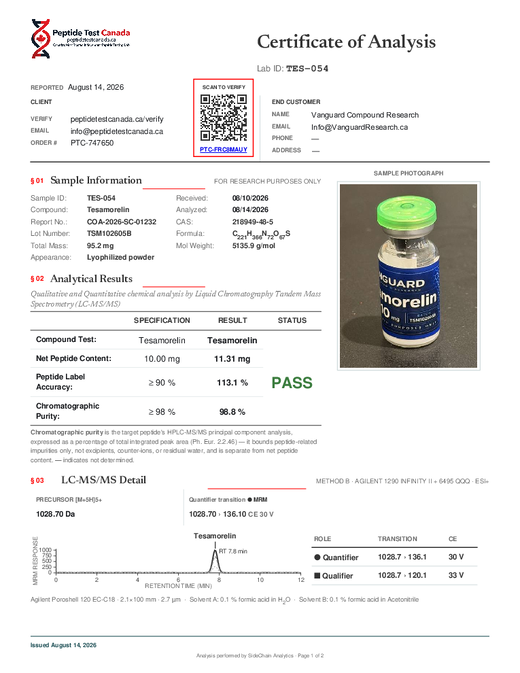
For Vanguard Compound Research material, the Certificate of Analysis should be used to report the applicable batch number, analytical method, chromatographic purity, measured peptide quantity, identity assessment and laboratory information.

Where testing has not been completed for a particular parameter, that parameter should not be presented as verified.

A Certificate of Analysis applies only to the sample and batch identified on that document. Results from one tesamorelin batch should not automatically be transferred to another production lot.

Storage and Stability

Tesamorelin is a peptide and may be affected by temperature, moisture, light, oxidation and repeated exposure to unsuitable environmental conditions.

Lyophilized research material should remain sealed and protected from excessive light and moisture. A specific storage temperature should be published only when supported by manufacturer stability information or batch-specific documentation.

Long-term stability cannot be inferred solely from chromatographic purity measured at one point in time. Stability studies require defined storage conditions and repeated analytical measurements over an appropriate period.

Analytical Limitations

A high chromatographic purity result does not independently demonstrate:

Sterility, endotoxin status, exact peptide quantity, absence of residual solvents, absence of water, biological potency, long-term stability, pharmaceutical equivalence or clinical safety.

Where these characteristics are important to an experimental design, they require their own appropriate analytical methods.

Likewise, matching the expected molecular mass supports chemical identification but does not by itself establish that the material has the same quality characteristics as an authorized pharmaceutical preparation.

Intended-Use Restrictions

Tesamorelin supplied by Vanguard Compound Research is intended exclusively as laboratory research material.

It is not supplied for human consumption, veterinary administration, injection, pharmaceutical compounding, diagnosis, treatment, mitigation or prevention of disease.

The research material should not be represented as EGRIFTA or another authorized pharmaceutical preparation.

Although tesamorelin itself has previously been investigated and marketed as a regulated prescription drug, clinical information relating to pharmaceutical tesamorelin does not establish the safety, suitability or effectiveness of independently manufactured research material.

Documentation Notice

These specifications describe the general identity, chemistry, physical characteristics, analytical boundaries and research classification of tesamorelin.

Final batch information should be based on the applicable Certificate of Analysis and manufacturing documentation. Where general reference information and batch-specific analytical documentation differ, the batch documentation should be reviewed before publishing a product-specific claim.

A Certificate of Analysis reports only the sample and tests described on that certificate. It does not establish pharmaceutical equivalence, regulatory authorization, clinical safety or therapeutic effectiveness.

For laboratory research only. Not for human or veterinary use.

TESTING METHODOLOGY

Each batch undergoes analytical review using validated laboratory procedures. HPLC testing is utilized to assess purity and compare the sample profile against established reference standards. Where additional verification is warranted, LC-MS analysis may be performed to support compound identity confirmation.

OUR ANALYTICAL VERIFICATION PROGRAM

  • Primary Testing: HPLC purity analysis and reference comparison
  • Identity Confirmation: LC-MS performed when indicated*
  • Quality Standards: Batch traceability, analytical documentation, third-party testing and storage procedures

*See LC-MS Confirmation Information for full details.

Every batch supplied by Vanguard Compound Research is assigned a unique batch number and maintained under documented quality-control procedures with supporting analytical documentation available upon request.

SHIPPING & FULFILLMENT

FULFILLMENT INFORMATION
Ships from Canada

All orders ship from within Canada.

Batch Documentation Available

Batch records and analytical documentation may be provided for qualifying products.

Secure Packaging

Products are packaged securely to ensure safe delivery.

Tracking Provided

Tracking information is provided for every shipment.

Temperature-Conscious Handling

Frozen or ambient-safe packaging used as appropriate.

All Vanguard Compound Research orders are shipped directly from within Canada, ensuring efficient delivery, reliable service, and consistent quality-control from fulfillment to arrival.

Canadian Researchers Benefit From:

  • Domestic shipping with no customs delays
  • Batch-specific third-party laboratory testing
  • Full lot number traceability on every product
  • Access to batch-specific Certificates of Analysis (COAs)
  • Dedicated customer support

Canada-Wide Fulfillment:

  • Orders processed Monday through Friday
  • Shipments dispatched throughout Canada
  • Discreet and secure packaging
  • Tracking provided with every shipment

Batch Documentation & Testing

Products are maintained under documented quality-control procedures to help ensure quality, consistency, and transparency.

  • HPLC purity analysis
  • Reference-standard comparison
  • Additional verification procedures (e.g. LC-MS confirmation) may be performed where warranted
  • Lot number traceability

Each product is assigned a unique lot number, allowing researchers to match their item directly to its corresponding Certificate of Analysis (COA).

Analytical Documentation

Supporting analytical documentation may be available for qualifying products, including batch-specific quality records and testing information.

Documentation may include:
  • Batch Number
  • Analytical Results
  • Traceability Records
  • Storage Information

RELATED PRODUCTS